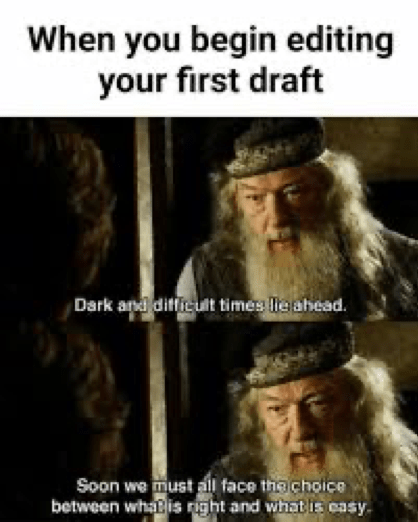
They say if you love something, you should let it go…but with writing, you shouldn’t.
If you love it, you’ll take the time to edit the living daylights out of it. It becomes less about your ego and more about making it into something beautiful and palatable for others to enjoy.
This is the third time I am going through my entire manuscript of my children’s fantasy novel, The Land in the Woods. The first two times I edited it, I added material, changed entire scenes, deleted parts that didn’t make sense, and all that jazz.
Then, I sent it to some friends who read books in this genre. Specifically, I sent it to people who have worked with children or who have children around the age of my target readers. I got some helpful feedback, and am now applying their comments. I will inevitably see changes I need to make along the way.
I have noticed a few areas for improvement on my own already:
- I tend to over-explain things. I know, I know, you’re supposed to show, not tell. But I really want to share all the gritty details I’ve worked out in my head! I imagine much of my editing will be going in and saying, “What is the least amount I can reveal here, and still have the reader understand what is going on?”
- I make my good characters a little too good at times…which takes away from the redemption aspect. Hmmm, how to make characters in a children’s book who are likable but need redemption…
- My descriptions can become slightly Edgar Allen Poe-esque if I allow them. You know, like how instead of saying, “the house was creepy and it made me depressed to look at it” Poe says:
I looked upon the scene before me –upon the mere house, and the simple landscape features of the domain –upon the bleak walls –upon the vacant eye-like windows –upon a few rank sedges –and upon a few white trunks of decayed trees –with an utter depression of soul which I can compare to no earthly sensation more properly than to the after-dream of the reveller upon opium –the bitter lapse into everyday life –the hideous dropping off of the veil. There was an iciness, a sinking, a sickening of the heart –an unredeemed dreariness of thought which no goading of the imagination could torture into aught of the sublime. What was it –I paused to think –what was it that so unnerved me in the contemplation of the House of Usher? It was a mystery all insoluble; nor could I grapple with the shadowy fancies that crowded upon me as I pondered. I was forced to fall back upon the unsatisfactory conclusion, that while, beyond doubt, there are combinations of very simple natural objects which have the power of thus affecting us, still the analysis of this power lies among considerations beyond our depth. It was possible, I reflected, that a mere different arrangement of the particulars of the scene, of the details of the picture, would be sufficient to modify, or perhaps to annihilate its capacity for sorrowful impression; and, acting upon this idea, I reined my horse to the precipitous brink of a black and lurid tarn that lay in unruffled lustre by the dwelling, and gazed down –but with a shudder even more thrilling than before –upon the remodelled and inverted images of the gray sedge, and the ghastly tree-stems, and the vacant and eye-like windows.
Edgar Allen Poe. The Fall of the House of Usher.
My own overly-descriptive verbosity looks like this:
The tree trunks were no longer grey, white, and brown, as they had been. Instead, the trees shone with bronze and golden hues, sparkling in the sun. The sun itself was no longer close to setting but rather was at its highest and most cheerful peak.
The silver path shone now more brightly, winding through the trees. All colors seem to have burst into flame, with a vividness and ethereal brightness which the children had never seen before.
What was more, instead of the minute chirping of birds which had previously provided ambiance, there now sounded a choir of uplifting birdsong around them. The birds’ melodious anthems were complemented with a soft accompaniment from their natural surroundings. The breeze rippled the brilliantly sapphire-colored grass like the strings of a harp, while also causing the branches of the trees to dance and shake like tambourines. The children were so overwhelmed by the myriad of stimuli that tantalized their senses that they hardly noticed that they, too, had changed.
Melissa May Younger, The Land in The Woods.
4. I repeat the same words and phrases.
Bobby paused his thrashing about mid-air, taken aback by the kindness in the bear’s voice. He paused and looked into the bear’s face.
Melissa May Younger, The Land in The Woods.
5. My narrator gets in the way. I love having a witty narrator who provides commentary. Occasionally this gets in the way of moving the story forward. My writing can become like the person at the party who is telling a story, and keeps cracking jokes and giving asides to everything they say. Oh wait, that’s me 😉
Here’s my talkative narrator in this story
You may wonder what was happening to the other two children during Maurie’s adventures, but the story of the middle child had to be told first because middle children, through a strange meting out of injustice, are almost always thought of last. We turn next to what happened to Janine after she entered through the door.
Melissa May Younger, The Land in The Woods.
6. I order my words, sometimes, in a way that makes for sentences that are awkward and don’t sound right (see?).
Thankfully, I pride myself on being a ruthless editor of my own work. I’m ready to continue tearing my work apart and putting it back together to make it the best it can be!
As many authors (though it is attributed to Faulkner the most) have said, “kill your darlings.” Although admittedly, I like to think of it more like redressing my darlings in more acceptable attire 🙂
I think about it this way: if I love what I am writing enough to share it with others, then I love it enough to give it the best editing job possible, in hopes of making it everything it can be.
What about you?
- Have you noticed some “areas for improvement” in your own writing, or had others help you discover them?
- What sorts of writing quirks bother you when you’re reading?
 Classic Reads
Writing is editing! Best wishes for getting your book wrapped up. I had to laugh at the Edgar Allen Poe part…ha! 😉
LikeLike
Haha, yes Poe loves his long-winded descriptions! Thanks 🙂
LikeLike