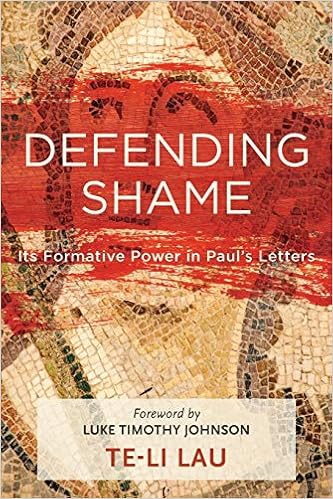
I really enjoyed reading this book by Dr. Te-Li Lau, my former Greek exegesis professor at Trinity Evangelical Divinity School. I appreciated the amount of scholarship and wisdom he brought to the current debates surrounding shame.
First, this is a Christian book with a scholarly approach to the subject of shame and Paul’s letters, so it’s not for everyone. It helped me think about shame from a more Biblical and godly perspective, and I want to share some of my findings here. Below are a few of my take-aways.
Not all shame is bad.
Lau quotes the popular Brene Brown, who says, “shame is lethal” or “destructive,” pointing out the current trend to view shame as something evil.
My own opinion is that shame, like other emotions, is neither good nor bad, but that it depends what is eliciting this response in us. Is it bad for me to feel shame if I slap an old lady in the face? No. Is it bad for me to feel shame for something that is not wrong? Probably.
There are two kinds of shame: the debilitating shame that we feel when we mistakenly think we’ve done wrong, and the good shame when we have done wrong.
The problem is, if you say ALL shame is bad, then we don’t have to feel badly about any of our actions, and we lose motivation to change our behavior. For a Christian, this is also a barrier to repentance. If you’re protecting yourself from feeling badly about sins you’ve committed, you won’t be able to truly repent.
Shame can be used for moral formation.
Lau’s main claim throughout the book is that Paul uses the emotion of shame as a pedagogical tool to steer his followers in a more godly way. Paul does this to other apostles, such as Peter, and to churches he writes to who are using their newfound freedom in Christ to do whatever they want.
The example I always think of in today’s culture is the type of parenting where the parent does not want to say “no” to their child when “no!” is exactly what the child needs to hear. There is this idea that saying no to a child is bad, as it shames the child and reinforces negativity.
Yet, we should have negative emotions about things that are bad or harmful. A good parent doesn’t say “let’s play at the table instead of hitting Jenny over the head.” The parent says “don’t hit!” and may discipline the child if he or she does.
Today’s morality often follows something along the lines of “it’s bad to feel bad,” and “it’s bad if someone makes you feel bad.” But all this does is try to protect someone from feeling bad, and doesn’t address the need for proper moral and emotional development. This is where we need shame.
Lau talks about two types: prospective and retrospective shame. The prospective kind is when we know ahead of time what types of actions will bring shame on ourselves or others and avoid those. Retrospective shame is when we feel shame about something we’ve already done.
Shame needs to be used with caution.
Not every wrongdoing should be shamed. Lau points out that shame should be used with caution, to bring reproach when someone doesn’t recognize that they’re done wrong.
If we start shaming people without discernment and without awareness of what is actually going on in their heart and mind, we can do great damage. When misused or abused, shame can make someone else feel worthless and hopeless.
We need to learn how to use shame in reintegrative ways.
This leads me to a final point. The church and Christians need to find ways to give a person their dignity and point them to Christ and His forgiveness while they are being corrected.
Reintegrative shame, a term Lau borrows from Braithwaite’s reintegrative shame theory, is shame that is meant to build up rather than tear down. Lau cites research that suggests:
“a higher ratio of reintegrative to stigmatizing communications increases the likelihood of inducing repentance and remorse in the offender; so also will conferences that begin with stigmatizing but end with reintegrative communications.”
Lau 184.
A Few Final Comments
Shame is painful. We want to avoid it. Yet, like anger, sadness, disappointment, and whole other slew of emotions we like to label as “bad,” it is a necessary part of our experience.
If we did not live in a fallen world, I don’t know that we would experience some (or all) of those emotions.
Yet, we do, and sometimes those emotions are reminders of sin and that things aren’t the way they should be. Instead of tuning out those reminders, we can tune in to reality and ask for God to come in and heal, bring justice, redeem, and forgive.
 Classic Reads