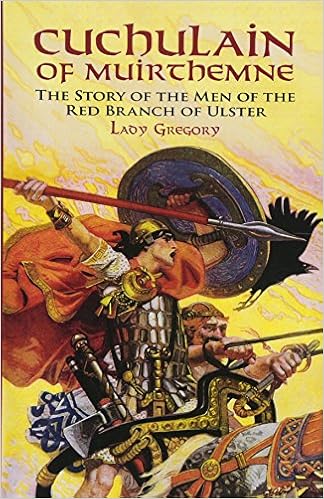
When I was studying abroad in Ireland during my senior year of undergrad, I had the privilege of taking an Irish mythology course. In it, I was introduced to Irish greats like Cú Chulainn and Fionn mac Cumhaill (Finn McCool).
I didn’t read them in Gaelic, although I have a deep appreciation for the language.
After many years, I dug up my Longman anthology of British Literature from the Middle Ages and was surprised to see Cú Chulainn there. Here’s my take on the short stories I read about him, as well as a little more background on the myths if you’re interested.
Where Did These Stories Come From?
Many accounts say the stories were passed down by oral tradition during the first few centuries until they were written down, but there is some disagreement about the dates.
As the stories go, Cú Chulainn was a hero of Ulster around the 1st Century. It stands to reason that the tales must have started after that point, but I believe there is no written evidence of them until at least the seventh century.
Cú Chulainn is referred to a different name (Setanta is his given name at birth in many) or alternative spellings (Cú Chulaind) as well, which adds to the confusion. Part of this is because he is renamed based on his deeds, as you will see in one of the tales below.
The Birth of Cú Chulainn
This is a very strange birth story. The tale opens with a legendary king of the Ulsterman, Conchobor, in his chariot with his daughter Deichtine. The land is devastated, and he and his men are driving chariots to chase away the birds. The birds fly and sing, enchanting the men. If I had to guess, they have something to do with what happens next.
The birds leave, it snows, and all the men seek shelter. In the shelter, the wife of the man of the house is giving birth. Deichtine kindly goes to help her. A boy is born, and at the same time, a mare at the entrance to the house gives birth to two foals.
The foals are given to the boy and Deichtine nurses him. In the morning, however, everything vanishes: the man, his wife, and the house. Conchobor, his daughter, and his men are left to care for the baby boy and the two foals.
Then, the boy dies. Deichtine cries for a while and then she turns to drinking, but a strange creature appears every time she tries to drink and prevents her from doing so. She has a strange dream about Lug, a pre-Christian deity in Ireland, who says she’s in his house and is now pregnant with his son. He will be named Setanta (Cú Chulainn’s original name).
Deichtine becomes pregnant, and no one knows who the father is. Conchobar’s men guess that it was him when he was drunk, and Conchobar then marries his daughter off to this guy, Súaltam. Deichtine is so embarrassed at being pregnant that she crushes the child within her and a split second later is pregnant by Súaltam. Súaltam is credited, in other accounts, as being the mortal father of Cú Chulainn.
My question is: at what point is Cú Chulainn born here?
As I recall, there are many different birth stories of Cú Chulainn, and the possibility that he was born more than once. If I had to guess, I would say Cú Chulainn was killed before he was born but was so clever or strong or something that he figures out how to be born again at a later time. This is mythology, so anything is game.
The Naming of Cú Chulainn
In this story, things are a little more straightforward. Cú Chulainn wins a bunch of games against all the other boys and ends up stripping them stark naked and humiliating them. There are many double entendres in this story about balls and sticks that are used in a game, but basically the point is that Cú Chulainn is the strongest and most manly.
Then, when Cú Chulainn is invited to Culann’s house for a feast, Conchobar forgets that Cú Chulainn is coming and tells Culann that everyone is there. Culann lets out his giant watchdog and it attacks Cú Chulainn while he is still playing.
The men of Ulster try to assist Cú Chulainn, but the boy outsmarts and overpowers the hound. When Culann finds out his watchdog has been killed, he laments, but Cú Chulainn offers to serve in place of the watchdog until a new one can be reared.
Thus, he is called Cú Chulainn, which means “hound of Culann.” It’s a pretty cool origin story.
Literary Connections
There are many connections between stories of Cú Chulainn and earlier mythology. Some have cited Hercules, as he is also a strong demigod character.
However, if you go back further, there are some parallels with the Sumerian Epic of Gilgamesh (dates around 2000BC).
Gilgamesh plays similar games with the young men of the town and shows his male prowess and strength. My husband (who studies ancient mythology) tells me there’s a story of of the Anzu bird being killed, and the one who kills it (Ningurzu, but this is also attributed to Marduk) becomes known for that, and names a temple after it. The connection is the association of the name of the creature that is killed with the person who killed it.
Other Resources:
Here’s a cool blog I stumbled across that does a good job telling some highlights of Cú Chulainn’s life:
https://www.rareirishstuff.com/blog/the-legend-of-c%C3%BA-chulainn.6889.html
And here’s a great article on him:
And here’s the Britannica article on him:
https://www.britannica.com/topic/Cu-Chulainn
The Cú Chulainn Roller Coaster?
Apparently they even have a Cú Chulainn Coaster now in Ireland:
 Classic Reads
Lol I didn’t know about a Cú Chulainn roller coaster! Uh… why?
I enjoy myths too, but even more so I love contemplating the mystery of lost Celtic mythology, lol. Like solving a crime novel!
Great post, will you do any more on Celtic legends?
LikeLiked by 2 people
Perhaps, but I can’t guarantee when…I confess I’m a bit of a mood reader and I constantly jump between different genres and time periods. For example, I plan to publish one on Crime and Punishment this weekend. I will probably be discussing some ancient creation myths soon, but those are Akkadian.
LikeLiked by 2 people