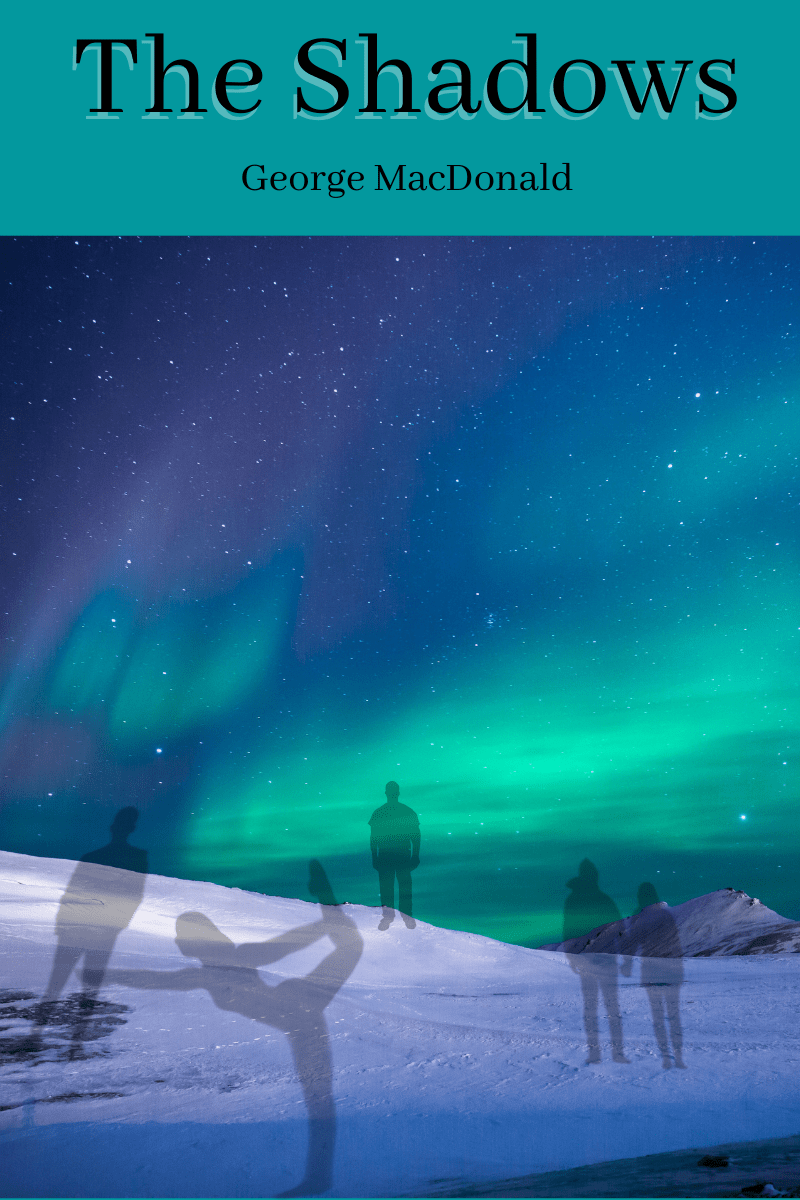
This is one of George MacDonald’s stranger tales. It is a fairytale of sorts, but also reads a little like a ghost story.
Throughout the story, I was trying to guess what the shadows were. The tricky thing is, not even the shadows seemed to know that.
The King of Fairyland Meets the Shadows
The story opens with the mortal king of fairyland, who is sick in his bed in London. MacDonald has this tongue-in-cheek way of adding irrelevant details which defy normal fairytale conventions:
Old Ralph Rinkelmann made his living by comic sketches, and all but lost it again by tragic poems. So he was just the man to be chosen king
of the fairies, for in Fairyland the sovereignty is elective.
The king meets some mischievous shadows when they start dancing on his wall and playing mind games with him. They claim to be his subjects, and tell him they want him to know them better.
Intrigued, the King asks to know more about them. They take him on a journey to their shadowland (which is in Iceland, naturally), where the aurora borealis is visible. There, they go to “church” before going about their night business.
In Shadowland
The king has never seen anything like the shadows:
The king had seen all kind of gnomes, goblins, and kobolds at his coronation; but they were quite rectilinear figures compared with the insane lawlessness of form in which the Shadows rejoiced; and the wildest gambols of the former were orderly dances of ceremony beside the apparently aimless and willful contortions of figure, and metamorphoses of shape, in which the latter indulged.
They retained, however, all the time, to the surprise of the king, an identity, each of his own type, inexplicably perceptible through every change. Indeed this preservation of the primary idea of each form was more wonderful than the bewildering and ridiculous alterations to which the form itself was every moment subjected.
From there, the king continues to try to understand what the shadows are. They claim they are “human Shadows,” but beyond that they don’t offer a concrete explanation.
The King meets many of the shadows and they regale him with stories of their exploits around the world. MacDonald raises many interesting moral, philosophical, and sociological points through these stories.
What Are the Shadows?
We learn a few things about the shadows:
- They are impish and like to play tricks on people.
- They try to point humans towards behaving better, or punish them for behaving badly (though only by frightening them or making them feel guilt).
- They can only come out at night.
- They are not human, but they can become human if they stay out too long.
- They only remember what happens each night, but have no recollection of the previous nights.
- They are not angels, as angels are spoken of as other kinds of beings.
Do you have any guesses of what the shadows might be?
At first, I thought the shadows were ghosts, but it turned out they had never been human. Then, I thought they were angels.
I finally surmised they are ambiguous beings who “haunt” humans. Perhaps they can be compared to the “angel and demon on the shoulder” idea, as they try to influence human behavior.
Literary Connections
This story definitely brought to mind Peter Pan’s relationship with his shadow. I am sure that J.M. Barrie was influenced by MacDonald, whose stories were well-known by that time.
If you want to see a deeper analysis, here’s an interesting article I found on this story: http://www.george-macdonald.com/resources1/the_shadows.html
You can read The Shadows for free on Project Gutenberg: http://www.gutenberg.org/ebooks/18859
 Classic Reads