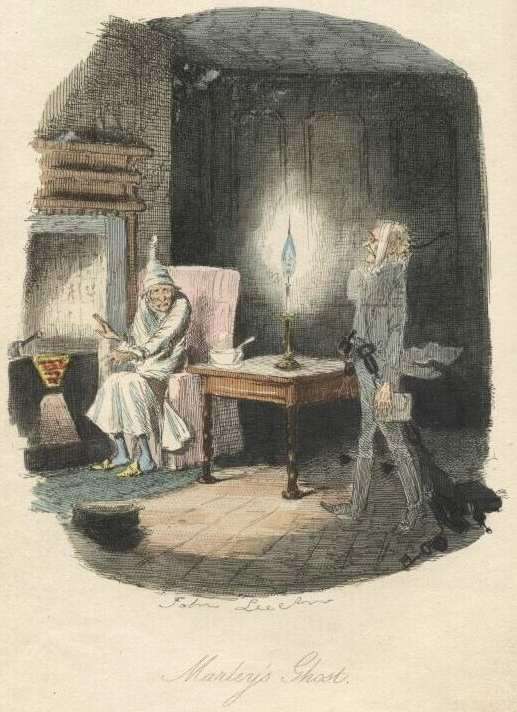
Perhaps one of the most well-known Christmas classics is A Christmas Carol, by Charles Dickens. The writing is phenomenal in its prose, but what is arguably most compelling about the tale are the characters and story arc Dickens creates.
What makes this piece so famous and why does it connect with people so well, leaving a strong impression on their memories?
You can get your own copy of to read along by clicking on one of the images below:


History
However, he instead cleverly presented his ideas in a Christmas story which, he notes in the preface, “I have endeavoured in this Ghostly little book, to raise the Ghost of an Idea, which shall not put my readers out of humour with themselves, with each other, with the season, or with me. May it haunt their houses pleasantly, and no one wish to lay it.”
Dickens attempted to make an otherwise politically unpalatable idea appeal to his fellow man.
The “Idea” he refers to, could be considered broadly to be goodwill, especially at Christmastime, but more specifically, he introduced the radical idea that “employers are responsible for the well-being of their employees. Their workers are not of value only to the extent to which they contribute to a product for the cheapest possible labor cost.”
Dickens was a very interesting man. You can read a book or watch a documentary about his life and writings by clicking one of the images below:


Christmas
The first two characters we are introduced to in the story, Scrooge and his nephew, Fred, introduce two contrasting opinions about Christmas. These ideas continue to be in dialogue with each other throughout the story. Scrooge is of the opinion that Christmas is:
“a time for paying bills without money; a time for finding yourself a year older, but not an hour richer; a time for balancing your books and having every item in ’em through a round dozen of months presented dead against you.”
Scrooge paints a sobering picture of cold-hearted, one-sided economic concern. Dickens has already made his readers dislike Scrooge through his initial description, and the way Scrooge feels about Christmas seals the deal.
Fred, on the other hand, offers a foil to Scrooge through his idealism:
“I have always thought of Christmas time, when it has come round—apart from the veneration due to its sacred name and origin, if anything belonging to it can be apart from that—as a good time; a kind, forgiving, charitable, pleasant time; the only time I know of, in the long calendar of the year, when men and women seem by one consent to open their shut-up hearts freely, and to think of people below them as if they really were fellow-passengers to the grave, and not another race of creatures bound on other journeys. And therefore, uncle, though it has never put a scrap of gold or silver in my pocket, I believe that it has done me good, and will do me good; and I say, God bless it!”
In the end of the tale, the latter view wins out, as Scrooge is converted. After the three ghosts, as well as his former partner, Marley, have done with him, Scrooge has been brought to a critical juncture where he sees the cruel consequences which have, and are, and will continue to result from his position. His hardness towards Christmas is actually a cover for his hardened heart towards his fellow men.
Charity
In fact, it is Scrooge’s hardened heart which disallows him to recognize the importance and good sense in charity. He is tight-fisted because he feels the poor do not deserve any better than their situation. He calls them “idle,” when asked to give to a charity which seeks to give food and drink to the poor for Christmas.
The theme of charity, or lack thereof, is furthermore presented in the person of Bob Crachit. Scrooge chastises Crachit for wanting to take the whole day off for Christmas, as Scrooge is still expected to pay Crachit for it. Scrooge sees it as an unfair expense, likening it to “pick[ing] a man’s pocket.”
Scrooge’s journey that night, however, takes him to the very people he was so quick to write off:
“The Spirit stood beside sick beds, and they were cheerful; on foreign lands, and they were close at home; by struggling men, and they were patient in their greater hope; by poverty, and it was rich. In almshouse, hospital, and jail, in misery’s every refuge, where vain man in his little brief authority had not made fast the door, and barred the Spirit out, he left his blessing, and taught Scrooge his precepts.”
The ghost of Christmas Present shows Scrooge the meaningfulness of charity and gives him practical tools for how to carry it out. At the end of the story, we see the result of this in his changed attitude and actions.
Illness and Death
A much more unpleasant, yet necessary theme is that of illness and death. Dickens makes sure his readers, along with Scrooge, see the results of poverty. Yet even Scrooge himself will not escape death, despite his wealth. Fred aptly states at the beginning of the book that all are “fellow-passengers to the grave.”
At the end of the tale, Scrooge is shown the sobering reality of this. He has already seen illness and death from the ghost of Christmas Present. Now he is shown his own death by the Ghost of Christmas Yet to Come, alone and friendless. Next, he sees the legacy he leaves. He is indirectly responsible for the death of Tiny Tim, whose father was not paid enough to get him the medical care he needs.
Fate
It is at this juncture, when he is shown such a dismal future, that the question of fate arises. Can Scrooge change the destiny he is shown? Does showing it predetermine it?
Scrooge appeals to logic, for why would the Spirit show him the morose things of the future if he couldn’t change them?
Scrooge promises, “I will honour Christmas in my heart, and try to keep it all the year. I will live in the Past, the Present, and the Future. The Spirits of all Three shall strive within me. I will not shut out the lessons that they teach.”
He then pleads with the Spirit of Christmas Yet to Come, “Oh, tell me I may sponge away the writing on this stone!”
Transformation
This brings us to our happy ending and the final transformation of Scrooge. Our story concludes with good news:
“Scrooge was better than his word. He did it all, and infinitely more; and to Tiny Tim, who did not die, he was a second father. He became as good a friend, as good a master, and as good a man, as the good old city knew, or any other good old city, town, or borough, in the good old world.”
Scrooge does change his fate. He learns from what the Spirits taught him and does, indeed, keep Christmas in his heart. As we said before, this is not merely a jovial holiday spirit, but rather a disposition towards his fellow men: one of goodwill and charity. He adopts his nephew Fred’s ideology in the end.
I would argue it is a transformation instead of a redemption (a word people like to throw around when something good happens to a character), because although Scrooge’s overall disposition is altered, and one can certainly infer a change of heart beneath it, there is no mention that his positive outlook and good deeds somehow redeem his past. People do not forget the way he was. They simply, “laughed to see the alteration in him.”
In addition to this, he has not escaped his ultimate fate. Not to throw a damper on things, but he will still die, and as he is already an old man, it cannot be far off. His transformation means he is a changed man, but he is still a mortal, grave-bound man. The difference now is in his reputation and a much more pleasant, charitable ride passage to the grave.
On a Personal Note
This is a well-loved story, by myself and many others.
I was first introduced to it though the Muppet version as a child:


This version actually preserves the story quite well, bringing a good deal of humor and breaking of the fourth wall with it.
I remember enjoying Stanley and Waldorf as “the Marley Brothers,” and laughing immaturely with my siblings at Scrooge’s love interest, who flares her nostrils an excessive amount while singing, “When Love is Gone,” although for some reason this was cut from the newer version on most DVDs.
When I was older I was able to appreciate the storyline more. I even got to see a live play of it in high school.
I suffered through “Scrooge: the Musical,” at one point, being forced to watch Albert Finney dance and sing. And who could forget Bill Murray’s modern version, “Scrooged.”


This timeless tale is a classic for a reason, and it is one worth sharing with your family this Christmas.
 Classic Reads
A Christmas Carol is my favorite holiday movie. I’ve seen many versions of it, but to date, the one with Patrick Stewart as Scoorge is my favorite.
I love the transformation of the character which shows even the hardest, coldest hearts can be changed. Of all Dickens’ work, this touches me more than any other. The message is timeless and I hope it continues to resonate for centuries to come!
LikeLiked by 1 person
That’s a great version, I’d forgotten about that one!
LikeLiked by 1 person
Reblogged this on Classic Reads and commented:
I recently did a vlog on Youtube on this using similar content: https://www.youtube.com/watch?v=tQnUBpgxHYQ&t=385s
I never get tired of revisiting this classic tale!
LikeLike