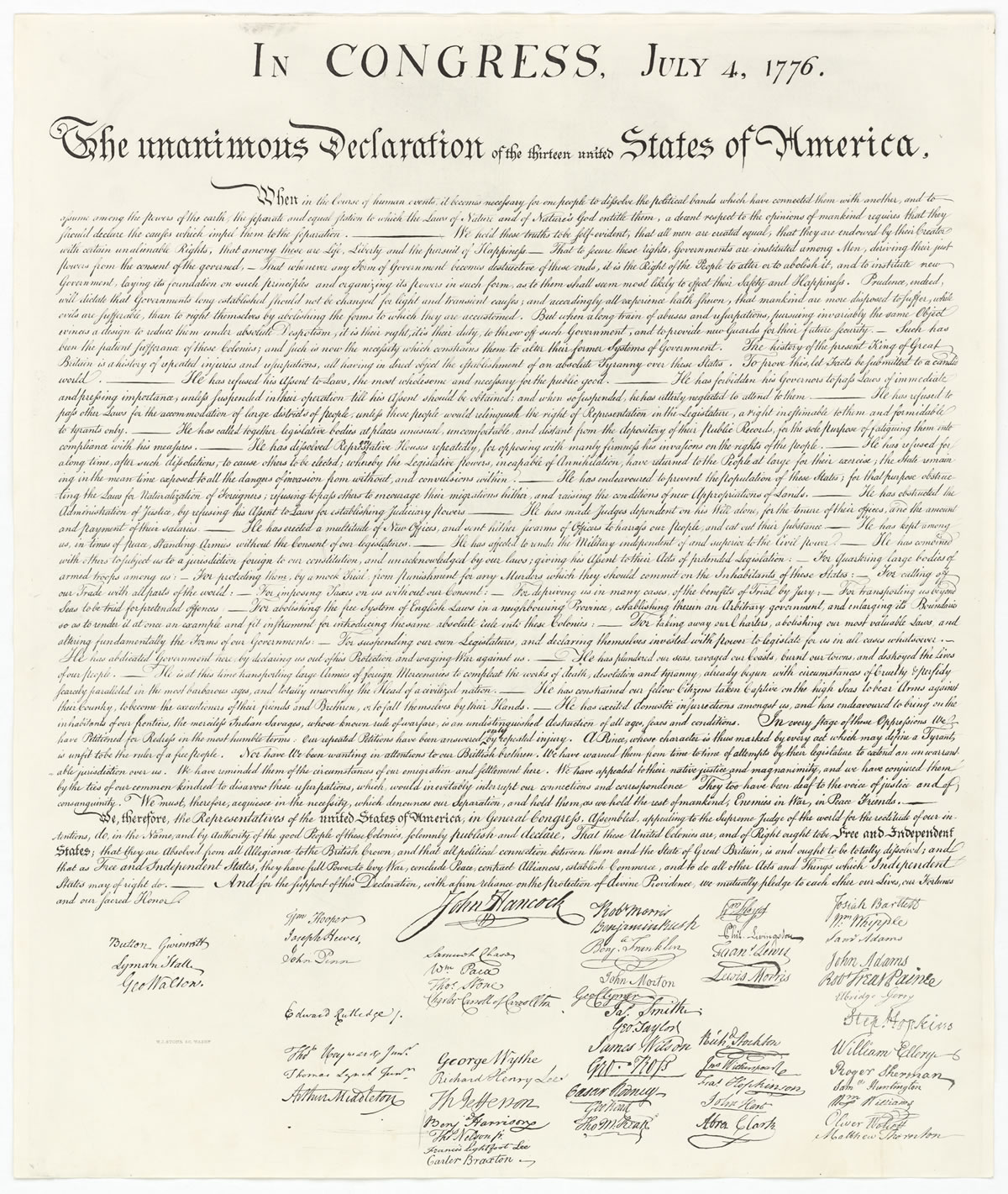
When Thomas Jefferson penned the Declaration of Independence, he was influenced by several great thinkers who had come before him, one being John Locke.
John Locke was a political philosopher in the late 1600s who wrote Two Treatises of Government, among other works. I wanted to share a quote from the second treatise, along with the area I think it connects with the Declaration of Independence.
SECOND TREATISE OF GOVERNMENT by JOHN LOCKE
CHAPTER. II.
OF THE STATE OF NATURE.
Sect. 4. TO understand political power right, and derive it from its original, we must consider, what state all men are naturally in, and that is, a state of perfect freedom to order their actions, and dispose of their possessions and persons, as they think fit, within the bounds of the law of nature, without asking leave, or depending upon the will of any other man.
A state also of equality, wherein all the power and jurisdiction is reciprocal, no one having more than another; there being nothing more evident, than that creatures of the same species and rank, promiscuously born to all the same advantages of nature, and the use of the same faculties, should also be equal one amongst another without subordination or subjection, unless the lord and master of them all should, by any manifest declaration of his will, set one above another, and confer on him, by an evident and clear appointment, an undoubted right to dominion and sovereignty.
The Declaration of Independence
We hold these truths to be self-evident, that all men are created equal, that they are endowed by their Creator with certain unalienable Rights, that among these are Life, Liberty and the pursuit of Happiness.
More about John Locke:
- https://www.britannica.com/biography/John-Locke/Two-Treatises-of-Government
- https://oll.libertyfund.org/pages/john-locke-two-treatises-1689
- https://plato.stanford.edu/entries/locke-political/#NatuLawNatuRigh
A Plea for Reading and Critical Thinking
With everything going on in the world right now, and the poor dialogue and political statements that are communicated via memes and tweets, I just want to say…
Whatever happened to reading, thinking critically, and writing thoughtfully?
Why can’t we take all the time and energy we spend trying to shame others and participate in virtue signaling and channel that into actually thinking deeply and having real conversations?
This is me, sitting over here socially distancing this July 4th and reading and thinking.
Feel free to share your own thoughts below!
 Classic Reads
One thought on “John Locke and the Declaration of Independence”