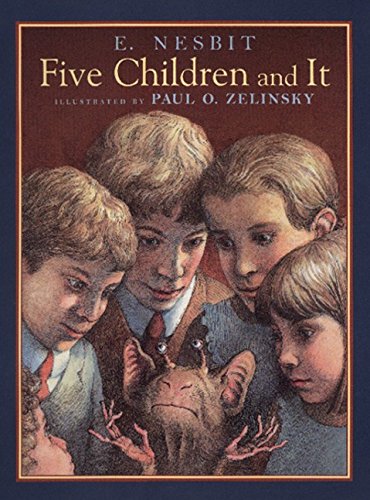
E. Nesbit’s Five Children and It is a fun, fanciful story with an underlying message to “be careful what you wish for.”
A New House
The story opens with the children moving into a new house, which is located at the top of a hill near a gravel-pit and orchard. Their new home has many places to explore around it, but the house proves to be dull.
This prompts the children to go out exploring, and thus their adventures begin.
Absent Parents
Absent or unavailable parents are one of the hallmarks of E.Nesbit’s books. This is probably because, if the parents were involved, the children wouldn’t be allowed to have their adventures.
In the story, the children’s father “had to go away suddenly on business,” while their mother was taking care of their sick grandmother. The servants make sure that the children are fed, washed, and clothed, but other than that, the children are on their own.
We find five siblings, in a large, new house and very little supervision, which always makes for mischief.


A Sand Fairy (Psammead)
Nesbit invents a grouchy, sneaky character who will teach the children a lesson. He is called a Sand Fairy, or a Psammead.
The children encounter the Sand Fairy on one of their outings, while they are digging in the sand on the beach.
We find out that the Psammead had been sleeping for thousands of years, but was once famous for its ability to grant wishes. It can grant wishes by huffing and puffing, but only has enough energy for one per day. Each of these wishes disappears at sunset, a rule for which the children become grateful.
The Woe of Wishes
The children do what any ordinary child would: they start wishing right away, without thinking about the consequences.
The first wish that they make is to be “as beautiful as the day.” This results in confusion when they get back home, as no one recognizes them. They are not allowed to come into the house and have dinner. Thankfully, when the sun sets, their wish disappears.
Their next wish, to have lots of gold, equally backfires. Everyone thinks that either the money is fake or the children have stolen it.
Their next wish, which is said in a moment of anger by one of the older brothers, is that everyone would wanted their baby brother (who they call Lamb). You can imagine some of the consequences this brings.
Every time the children’s wishes go wrong, they learn some kind of lesson.
The undergirding message is not only be careful what you wish for, but also an introspective, what do you really value?
I think another lesson along the way is to learn to be thankful instead of always wanting.
Nesbit didn’t write this story as a moral tale, but she notes in the book that morals have a way of creeping into stories.
Literary Connections
As I read this, it made me think of W. W. Jacob’s The Monkey’s Paw, a short story published in 1902 (consequently, the same year Five Children and It came out!).
Both stories are Faustian tales, though Nesbit’s has much more levity in it. In her story, something terrible could result from the wishes, but then the children end up with a less severe consequence. In The Monkey’s Paw, there is an element of the cruelty of fate, which determines horrid outcomes for us no matter how we try to wish them away.
My guess is that these authors just had similar ideas around the same time, as I couldn’t find a definite link between these works. Perhaps this just points to a popular trope at that time.
Movie Adaptations
I have to admit, I was not impressed with the newer movie version when I saw it, as it gives off more of an A Series of Unfortunate Events vibe:
This version changes the story and lesson completely, adding several villain characters and making the Psammead seem smarmy and rude.
I think the older BBC version captures the story a little better, and the Psammead comes off more like a cute Yoda character than an alien. You can watch segments on Youtube:
I am planning to read the next 2 books in this trilogy by E. Nesbit.
Have you read her books and do you have any favorite stories by her?
 Classic Reads