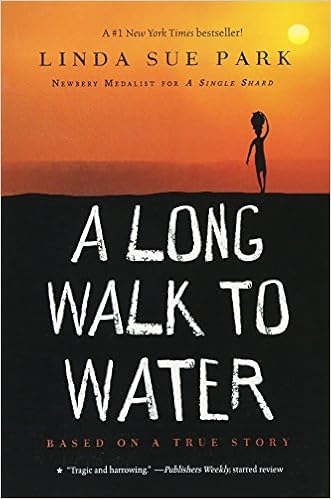
We often take resources such as water for granted, but this story shows the struggle of different tribes in Sudan to get clean water.
In Linda Sue Parks’ A Long Walk to Water, she follows two stories in two different time periods in Sudan.
The First Story: A Boy, Running for His Life
The main story is based on the true account of a boy named Salva.
It’s 1985 and a civil war rages on, driving Salva and his family from his village. Rebels from South Sudan have been fighting against the government, who want everyone to be Muslim.
For most of the book, you follow Salva’s perilous journey through the wild with different groups from the Dinka tribe. They encounter lions and crocodiles, and must survive the barren Akobo Desert.
All the while, Salva’s driving purpose is to be reunited with his family.
Salva’s story is heartbreaking. He loses many people he loves along the way.
Through all of his hardships, Salva learns to cope by reminding himself to take “one day at a time.”
Salva learns to face obstacles by focusing on the present and simply getting to the next step. That’s something we could all learn to do a little more.
The Second Story: A Girl in Need of Clean Water
The second story follows a fictional girl, Nya, in her daily life in 2008.
Nya has to make a long trip to get enough water for her family every day. Their lives revolve around having enough water to survive.
Nya can’t carry too much, so they can’t boil it. As a result, her sister gets very ill from the water.
One day, someone from a warring tribe comes to help them…
You’ll have to read the book to see how these two stories meet. 🙂
My Review
Overall, this book was an easy, quick read. It was also thought-provoking, and makes you want to take action.
If you want to help these people who desperately need clean water, you can do so at: https://www.waterforsouthsudan.org/
This book was given to me by a friend, and is not a classic (but could become one!). It is, however, a #1 New York Times Bestseller.
An Aside
Sometimes people object that putting in clean water wells/ pumps may disrupt the community. For some tribes, a shared water source nearby is reason to keep the peace.
If people are dying from dehydration or diseases in the water, I think the water pumps are essential. Once they are no longer facing those day-to-day issues, they can focus on other ones.
In this story, a native who understood the people and the land started a water project to help them. I think that is an ideal scenario.
 Classic Reads