Jane Austen (Action Figure) Adventures

For you, it’s another ordinary, “there’s still a worldwide pandemic and when will things be normal again” kind of day.

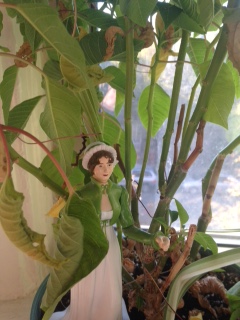
For Jane, things are far more complicated. She’s a six inch tall action figure from the Victorian period, stuck in a confusing, gigantic, 21st-century apartment.

Join our classic author as she bravely faces each challenge. Her “courage always rises with every attempt to intimidate” her.

“What a lovely day for a stroll in the garden!”

“Oh no! My skirt is all soiled.”

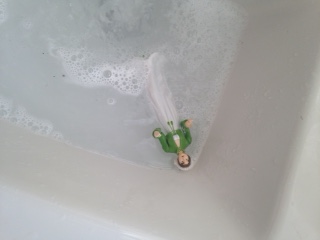
“A hot bath was just what I needed!” #selfcare

“Oh no! I can’t reach the faucet to turn it off! Whatever will I do? I don’t know how to swim!”

Stay Tuned…

The Story Behind Dr. Jekyll and Mr. Hyde

cover

Robert Louis Stevenson wrote the mysterious, The Strange Case of Dr Jekyll and Mr Hyde in six weeks, but the story was probably brewing in Stevenson’s mind long before that.

The story quickly became popular, as gothic horror stories were “trending” at the time.

Stevenson said that the story came to him in a feverish dream when he was ill. But what many don’t know is that Stevenson most likely based the struggle of Dr. Jekyll and his devilish counterpart off of a real person.

William Brodie had been a respected cabinet-maker and member of society in Edinburgh. He had even made furniture for Stevenson’s father. The truth was, however, Brodie led a double life.

By night, the respectable man became the leader of burglars, a philandering vagrant, and a gambler (background taken from here).

But why would Stevenson be inspired by and fascinated by such a man?

At the time, the Victorian values of society dictated a respectable person’s conduct. In Stevenson’s Jekyll and Hyde, we see this personified by Jekyll. Jekyll explains at the end that he felt trapped in the monotony and dullness of leading the private, respectable life of a scholar.

Stevenson, no doubt, felt the moral constraints of society. Indeed, he left these behind to marry his wife, who was a recently divorced 36 year old to his 25.

In Stevenson’s book, Jekyll’s sinful nature eats away at him as fleshly desires beg for an outlet. Jekyll feels torn, not wanting to compromise his position in society, but desperately wanting to give in, even just for a moment, to his more baser instincts.

Thus, Jekyll devises his brilliant plan: to create an alter ego who is unrecognizable. As Hyde, Jekyll can go and carry out the misdeeds he desires and return to his former, respectable self without consequence. The plan seems foolproof.

However, as with the historical Brodie, who was hung for his crimes, there are always consequences.

Exploring the Human Condition

I enjoyed reading this book because it plumbs the depths of the human condition. It examines the implications of a person leading a double life. It is more than a creepy tale to make our spines tingle; It sheds light on what happens when we begin to feed our darker side, little by little.

The truth is, we all lead a double life in one way. To survive, to make friends, and to like ourselves, we pay attention to our nice and acceptable parts. Yet, we all have parts of that are wild or that toy with the idea of doing something wicked.

And, in some ways, small or big, we carry out our wicked agendas. Some of us are obvious in our unholy pursuits, while others employ manipulation and deception (of self or others).

Here, Stevenson shows this struggle in a single character, who wants to satisfy both aspects of his nature. Therefore, this leads to a split: one moment he is the kind and good Jekyll, the next he is the cruel, lustful Hyde.

Building the Mystery

Stevenson effectively builds suspense and mystery throughout this story. This was a common element of gothic novels, to build up to the moment when the man encounters the horrible thing (which might not actually happen). It is all about the suspense and creating a dark, gloomy atmosphere where the reader is wondering what terrible thing the main character will discover next.

The mystery comes to a head after Hyde murdered a man and escaped. Everyone is looking for him. Then, Mr. Utterson visits Dr. Lanyon, a mutual friend of himself and Dr. Jekyll, and his suspicions about the connection between Hyde and Jekyll are aroused. Soon after, Dr. Lanyon succumbs to an illness which resulted from a serious shock, having to do with Jekyll.

Utterson is torn. Should he visit his friend, who has now locked himself away, when he has reason to suspect him of something terrible? Stevenson shows the inner struggle:

It is one thing to mortify curiosity, another to conquer it; and it may be doubted if, from that day forth, Utterson desired the society of his surviving friend with the same eagerness. He thought of him kindly; but his thoughts were disquieted and fearful.

Robert Louis Stevenson. The Strange Case of Dr. Jekyll and Mr. Hyde.

The Lawyer as the Protagonist

The protagonist, Mr. Utterson, is portrayed as a morally upright man, loyal friend, and outstanding citizen, driven by duty. He is the lawyer handling Jekyll’s case and trying to unravel the mystery.

In short, Mr. Utterson embodies the kind of man who society appreciated and respected at the time. It is therefore understandable when Utterson is horrified to find that his respected friend Dr. Jekyll is keeping such disreputable company as Mr. Hyde (or so he thinks).

Stevenson couldn’t tell the story from Jekyll’s POV, as that would have given away the mystery from the beginning. Additionally, Jekyll is arguably not the protagonist because, even as Jekyll he does not embody the necessary goodness of Victorian values.

My Recommendation

This book is great to read if you are looking for something with an engaging mystery, a slow-moving but short plot line, and something with a good balance of description and dialogue/ action. I am impressed with Stevenson’s writing, characters and ideas so far. Treasure Island is on my reading list, and I look forward to delving into that one early next year, or perhaps sooner if I am curious enough.

I would love to hear from you!

  • Have you read this book? What are your thoughts on the themes and characters?
  • Do you think humans have this dual nature? If so, How do you think people deal with it?
  • Have you read other works of Robert Louis Stevenson you would recommend?

You can read the ebook here for free.
Creepy Classics

As the days get shorter and drearier, and Halloween approaches, let’s look at some creepy classics together.

I just finished reading The Strange Case of Dr. Jekyll and Mr. Hyde (I will blog on this later this week), and am moving on to Dracula and Frankenstein. If you are interested in reading (or watching) these free creepy classics, check out some of these versions:

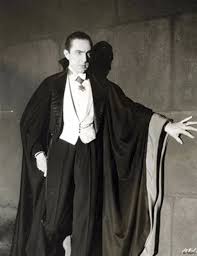
Dracula

The classic vampire tale, before Twilight and the millions of others.
How opium-fuelled orgies and lightning gave birth to Mary Shelley's  Frankenstein

Frankenstein

Frankenstein is the name of the crazy scientist, not the creature.

Or, if you want a mash-up, here’s Abbott and Costello Meet Frankenstein, which has them both.

The Strange Case of Dr. Jekyll and Mr. Hyde

Woven with mystery, this tale is more than meets the eye.

In my opinion, creepy isn’t the same as good.

I’ll be honest: I don’t look for creepy books to read. Sure, when I was younger I used to read collections of ghost stories and I even read a few Goosebumps, but I generally gravitate towards happy stories. In fact, I’m a little sensitive to overly dark material.

What draws me to these books is the deeper element that makes them creepy: they delve into the darker side of the human condition.

These books answer questions such as:

  • What if you could live forever, at the expense of other human life?
  • What if you could reanimate human flesh with science (or so-called natural philosophy)? Would the thing still be human?
  • What if you could take a potion that would allow you to assume another identity, where you could give yourself over to vice, and then return to your former identity without repercussions?

I don’t like to dwell on the darker aspects of human nature, but I believe it is important to acknowledge them.

These tales call for introspection when we are tempted to judge the characters. We can examine our own dark sides and check our moral compass. As a Christian, self-examination and repentance of the sin of my darker side is important to me. Strength and purpose are found in seeing sin for what it is, and purposefully turning from it.

Join me as I take a look at these spine-tingling tales!

10 Essential Fiction-Writing Tips

If you’re a fiction writer, like me, then you love to use your imagination. You might have lofty ideas for your next novel or be in the middle of crafting a stellar short story. Whatever your jam is, I promise that these tips are for you.

  1. Write about what you love. Remember that one teacher who was passionate about the subject they taught? It made them more interesting to listen to, right? Such is the case with writing. Trust me, you don’t want to spend hours learning and writing about something you’re not interested in, and it’s going to show. I’ve read blogs and books where it’s obvious that the writer is trying to write in a specific category to attract readers, but the writing doesn’t seem to flow from a natural interest. It might be technically accurate, but there’s no heart behind it.
  2. Keep an element of mystery. As a writer, I am guilty of inundating my readers with details and giving things away too early, worrying that my readers will stop reading if they don’t understand everything. But as a reader, the mystery is what keeps me reading! It’s important to keep in mind that even if the genre you’re writing in isn’t mystery, you need to weave a mystery throughout your book.
  3. Keep things simple. They used to say a newspaper should be written at a third grade reading level, to keep the reader engaged. People don’t want to have to sift through difficult sentences and words they don’t know to get to the story. The same is true for your book. Think: how can I get this point across using less words and simpler sentences? You don’t want to oversimplify, but the point is to bring clarity to your writing.
  4. Break your writing into manageable pieces. Give yourself deadlines and set monthly and weekly writing goals. I also set daily goals, but to be honest you never know what unexpected events will interrupt your daily plan, so I like to set my weekly goal at a reasonable amount (let’s say 5,000 words, assuming you don’t write for a living). That gives you the flexibility to do 2,500 words one day, and 500 the next. You can work as you are able and inspired, and still meet your goals.
  5. Give your story structure. Does it have a beginning, middle, and end? Or, do your characters meander through your tale aimlessly, doing things and experiencing things that seem unconnected? Don’t feel like you have to follow the ordinary story structure. There are many different types. The point is, make sure your story is dynamic and that its parts connect. I appreciate the humor with which Kurt Vonnegut approaches story arcs.
  6. Develop your characters. No one wants to hear the story of how a bunch of things happened to Joe, and he remained largely unchanged and disinterested in all of it. You need to make your main character interesting or relatable, and he should go through some kind of transformation. Even if you don’t tell the backstory of the characters in your story, you need to know it. It will inform decisions you make about what your character does in the narrative.
  7. Limit the use of the passive voice. The passive voice is not as engaging, and can make it seem like your characters and the world are being acted upon, but are largely disengaged. For example: “Susie was taken to the hotel by a friendly driver. The driver was distracted by a pigeon that was hit by the car windshield. “Oh no!” was shouted by the driver. Susie was forced to walk.” Exaggerated, but you get the point.
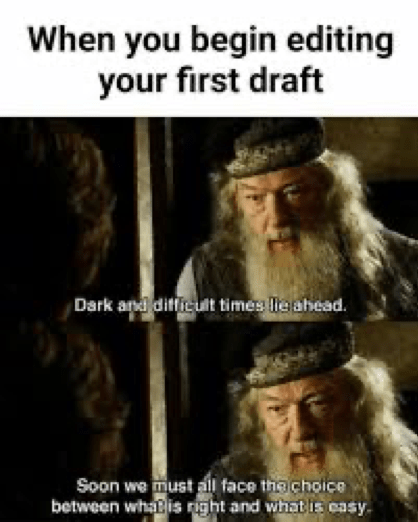
  8. Be a ruthless editor. Be willing to cut out sections, sentences, and even characters that aren’t needed in the story. And if you want to leave it in there, make sure it does serve a purpose. A reader shouldn’t be wondering why you took the time to introduce a new character who never appears again and didn’t move the plot forward. While you’re writing, let the content flow freely, but when you’re ready to edit, try to be picky about what you leave in. If you have trouble editing your own content, you should consider swapping manuscripts with another writer or getting some professional editing done to help you to improve in your craft.
  9. Read! Reading can expose you to different styles, genres, and vocabulary. If you’re writing in a specific genre, you’ll want to read books from that genre to get an idea of what is considered standard.
  10. Know your audience. If you don’t know who you are writing your book for, you won’t know the level of writing, the style, or the vocabulary to use. Writing a middle grade fantasy novel is different from writing an adult epic fantasy. In one, you would have younger and fewer characters, and be telling a simpler story in simpler language. In the other, you would be creating a complex world peopled with many characters and would probably use more poetic, complex language. You’ll also want to keep in mind that your characters should match your audience in terms of their age level and experience.

What about you?

  • What kind of fiction do you write?
  • How have you grown as a fiction writer?
  • Any fiction-writing tips you’d like to share?

If You Love Your Writing, You’ll Edit It.

They say if you love something, you should let it go…but with writing, you shouldn’t.

If you love it, you’ll take the time to edit the living daylights out of it. It becomes less about your ego and more about making it into something beautiful and palatable for others to enjoy.

This is the third time I am going through my entire manuscript of my children’s fantasy novel, The Land in the Woods. The first two times I edited it, I added material, changed entire scenes, deleted parts that didn’t make sense, and all that jazz.

Then, I sent it to some friends who read books in this genre. Specifically, I sent it to people who have worked with children or who have children around the age of my target readers. I got some helpful feedback, and am now applying their comments. I will inevitably see changes I need to make along the way.

I have noticed a few areas for improvement on my own already:

  1. I tend to over-explain things. I know, I know, you’re supposed to show, not tell. But I really want to share all the gritty details I’ve worked out in my head! I imagine much of my editing will be going in and saying, “What is the least amount I can reveal here, and still have the reader understand what is going on?”
  2. I make my good characters a little too good at times…which takes away from the redemption aspect. Hmmm, how to make characters in a children’s book who are likable but need redemption…
  3. My descriptions can become slightly Edgar Allen Poe-esque if I allow them. You know, like how instead of saying, “the house was creepy and it made me depressed to look at it” Poe says:

I looked upon the scene before me –upon the mere house, and the simple landscape features of the domain –upon the bleak walls –upon the vacant eye-like windows –upon a few rank sedges –and upon a few white trunks of decayed trees –with an utter depression of soul which I can compare to no earthly sensation more properly than to the after-dream of the reveller upon opium –the bitter lapse into everyday life –the hideous dropping off of the veil. There was an iciness, a sinking, a sickening of the heart –an unredeemed dreariness of thought which no goading of the imagination could torture into aught of the sublime. What was it –I paused to think –what was it that so unnerved me in the contemplation of the House of Usher? It was a mystery all insoluble; nor could I grapple with the shadowy fancies that crowded upon me as I pondered. I was forced to fall back upon the unsatisfactory conclusion, that while, beyond doubt, there are combinations of very simple natural objects which have the power of thus affecting us, still the analysis of this power lies among considerations beyond our depth. It was possible, I reflected, that a mere different arrangement of the particulars of the scene, of the details of the picture, would be sufficient to modify, or perhaps to annihilate its capacity for sorrowful impression; and, acting upon this idea, I reined my horse to the precipitous brink of a black and lurid tarn that lay in unruffled lustre by the dwelling, and gazed down –but with a shudder even more thrilling than before –upon the remodelled and inverted images of the gray sedge, and the ghastly tree-stems, and the vacant and eye-like windows.

Edgar Allen Poe. The Fall of the House of Usher.

My own overly-descriptive verbosity looks like this:

The tree trunks were no longer grey, white, and brown, as they had been. Instead, the trees shone with bronze and golden hues, sparkling in the sun. The sun itself was no longer close to setting but rather was at its highest and most cheerful peak.

The silver path shone now more brightly, winding through the trees. All colors seem to have burst into flame, with a vividness and ethereal brightness which the children had never seen before.

What was more, instead of the minute chirping of birds which had previously provided ambiance, there now sounded a choir of uplifting birdsong around them. The birds’ melodious anthems were complemented with a soft accompaniment from their natural surroundings. The breeze rippled the brilliantly sapphire-colored grass like the strings of a harp, while also causing the branches of the trees to dance and shake like tambourines. The children were so overwhelmed by the myriad of stimuli that tantalized their senses that they hardly noticed that they, too, had changed.

Melissa May Younger, The Land in The Woods.

4. I repeat the same words and phrases.

Bobby paused his thrashing about mid-air, taken aback by the kindness in the bear’s voice. He paused and looked into the bear’s face.

Melissa May Younger, The Land in The Woods.

5. My narrator gets in the way. I love having a witty narrator who provides commentary. Occasionally this gets in the way of moving the story forward. My writing can become like the person at the party who is telling a story, and keeps cracking jokes and giving asides to everything they say. Oh wait, that’s me 😉

Here’s my talkative narrator in this story

You may wonder what was happening to the other two children during Maurie’s adventures, but the story of the middle child had to be told first because middle children, through a strange meting out of injustice, are almost always thought of last.  We turn next to what happened to Janine after she entered through the door.

Melissa May Younger, The Land in The Woods.

6. I order my words, sometimes, in a way that makes for sentences that are awkward and don’t sound right (see?).

Thankfully, I pride myself on being a ruthless editor of my own work. I’m ready to continue tearing my work apart and putting it back together to make it the best it can be!

As many authors (though it is attributed to Faulkner the most) have said, “kill your darlings.” Although admittedly, I like to think of it more like redressing my darlings in more acceptable attire 🙂

I think about it this way: if I love what I am writing enough to share it with others, then I love it enough to give it the best editing job possible, in hopes of making it everything it can be.

What about you?

  • Have you noticed some “areas for improvement” in your own writing, or had others help you discover them?
  • What sorts of writing quirks bother you when you’re reading?

Foil Characters in Journey to the Center of the Earth

Journey to the Center of the Earth is a story with few main characters. For the entirety of the book, the two main ones are Axel, the nephew, and his Uncle Lidenbrock. They serve as foil characters to each other, which makes for an intriguing and often exasperating tug of war throughout the book.

Axel

Let’s take a look at Axel first, as he is also the narrator and protagonist.

One humorous point of the story is Axel’s relationship with his beloved fiancé, Grauben. At the beginning of the story, he expects her to try to talk him out of going on a perilous, potentially fatal journey to the center of the earth. Instead, she surprises him by encouraging him to risk his life for the scientific glory:

“Yes, Axel, a journey worthy of the nephew of a savant. It is right for a man to distinguish himself by some great enterprise.”

“What! Grauben! Wouldn’t you dissuade me from attempting such an undertaking?”

“No, dear Axel. I would gladly accompany you and your uncle, but a poor girl like me would only be an encumbrance.”

Jules Verne. Journey to the Center of the Earth.

In their conversation, Axel’s fiancé basically tells him to man up and go on this quest where he might die. And he’s thinking: if she cares about him, why does she want him to go? Axel is perplexed by this, as he is a very logical, level-headed thinker. Why take an unnecessary risk for unlikely glory? he wonders.

Axel is a pragmatic who only takes necessary risks. At times he appears “wimpy,” but only in comparison to his uncle. He is unadventurous and spends most of the book being angry at his uncle for dragging him on a fool’s errand, and for disregarding his safety and wellbeing.

Uncle Lidenbrock

Axel’s Uncle Lidenbrock is the opposite of him. Lidenbrock is called a savant throughout the book, and has a vast knowledge of linguistics and geology. He knows many theories, yet is skeptical of them. At times, it seems he would like nothing better than to die in the glory of disproving a scientific theory.

Lidenbrock is stubborn, intelligent, domineering, and eccentric. When he gets an idea, he will follow it, aggressively recruiting others to do the same.

Near the beginning of the story, the first incident of Lidenbrock’s eccentricity is when he makes the cook and Axel stay in the house, locked and without food, until he cracks the code on the piece of parchment. He is willing to starve Axel to death for the sake of making a scientific discovery, even though starving him does not help Lidenbrock in any way.

Lidenbrock continues this brand of madness throughout the story. He sees it as weakness to give into basic human needs. Lidenbrock later risks the life of Axel and their guide, Hans, to make a scientific discovery greater than anything anyone else has made.

Adaptations of Journey to the Center of the Earth

There have been many film adaptations of this story, and all of them add characters and more excitement than the book (very little actually “happens” in the first 2/3 of the book).

Here’s a 1959 version.

There was one made in 1988, and is free on Amazon Prime (at least, right now).

And then there’s the most recent version, from 2008.

All versions put their own twist on it to make it more appealing to a modern audience. To be honest, this was one book where I understood why people lose patience with Classics. You have to dig beneath a mountain of 101 facts that Jules Verne thinks are cool to find the storyline.

Still, it was an enjoyable read and I recommend it to those who enjoy a good nerdy read.

A Trip to an Outdoor Mall

The other day, my husband’s wifi wasn’t working. We had to go to the Apple store, which happened to be in an outdoor mall.

While I was waiting for him, I enjoyed walking around there. They have some really nice displays. Here are some pictures I took of the Old Orchard Mall near Chicago.

They had beautiful floral displays all over
They had many statues, such as this lion
Koi Pond
It was hard to get a good picture of the Koi!

How good it felt to be outdoors and doing something! Especially as the weather was wonderful. I was thankful for the excursion and impromptu date night with my husband.

The Genius of Jules Verne in Journey to the Center of the Earth

Genius is a word that is thrown around too often nowadays, but after reading Journey to the Center of the Earth, I think Jules Verne is one person who deserves that title.

This book was really fun to read and I’ve enjoyed seeing why it is such a Classic.

My first thought when I started reading this book was: Jules Verne is very smart. He created very intelligent characters, such as the savant Uncle Lidenbrock. As most writers know, to have intelligent characters speak intelligently, the writer has to be even more intelligent. And intelligible, if they want their readers to keep reading.

Verne talks about specific geological, geographical, and linguistic theories that most people don’t know, and you have to remember that he was writing in an era without internet. He had to learn about all of these things from studying.

Imagine– he read books! He had to have all of the information he includes in his book on hand.

Geological Overload

I enjoyed learning about some scientific ideas throughout this book, but at times I felt a little lost. Journey to the Center of the Earth is incredibly dense!

Journey to the Center of the Earth is pre-science fiction, but is one that people point to as an origin of this genre. I can definitely see why. There are many cool events in the narrative where Verne explores various scientific theories using his characters.

One example is when the narrator and main character, Axel, gets separated from his uncle and their guide. He tries to backtrack along the tunnel to find them.

Finally, Axel hears his uncle’s voice from a great distance, but is stumped at first as to how he is able to hear Lidenbrock.

“Then I understood it all. To make them hear me, all I had to do was to speak with my mouth close to the wall, which would serve to conduct my voice, as the wire conducts electric fluid…I went close to the wall, and I said, slowly and distinctly: “Uncle Lidenbrock!” And I waited with painful anxiety. Sound does not travel quickly here. The density of the atmosphere increases its intensity but not its velocity.”

Jules Verne. Journey to the Center of the Earth.

I can appreciate the amount of thought that went into crafting the imagined scientific discoveries of Verne’s characters. He accounts for scientific variables (such as an increase in atmospheric density as they travel deeper into the earth) to make his story seem more plausible.

Verne boldly has his characters debunk popular scientific theories of the day, such as that the Earth’s core is incredibly hot and that life could not be sustained down there. Instead, Verne’s characters discover that there is a whole other world deep underneath the Earth’s crust.

Tricky Linguistics

Another element I enjoyed was the linguistic knowledge Verne uses. Before Axel and his stubborn Uncle Lidenbrock discover the underground passage in Iceland, they find a dirty parchment in an old book the professor had purchased, which has an encoded message on it. To understand the message, they must crack the code.

It is Axel who discovers the cipher and is able to decode the message. This is no easy feat, as to get to this point, he had to track with his savant Uncle Lidenbrock, who transcribes the ruins and waxes eloquently about Latin, French, and Icelandic.

As a humorous, somewhat unrelated aside, Here are some truly tricky linguistics by some of my favorite comedians, Fry and Laurie (before Hugh Laurie became famous in the U.S. on the show House):

There are many other interesting elements to this story I’d like to discuss, but I think those will have to be in another post.

What about you?

  • Have you read a book that had so much information and technical terms that it lost you at some points?
  • Have you read/ enjoyed Journey to the Center of the Earth or other classics by Jules Verne?

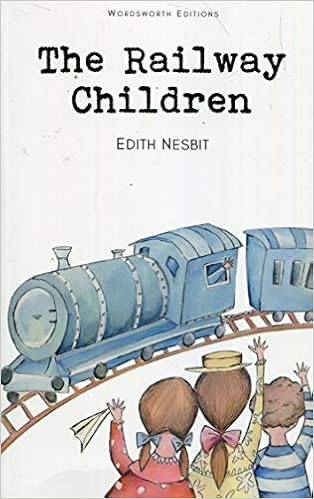
Funny Misunderstandings of Grown-Up Speak in The Railway Children

This is my last post about the Railway Children, I promise.

One element that I loved in this book, other than the playfulness of the parents, is the misunderstandings of grown-up actions and phrases by the children.

Imitating Things Grown Ups Say

After the children’s father is arrested, the children try not to fight, for their mother’s sake. In their discussion, Roberta comedically attempts to use a grown-up phrase:

“There’s nothing to be good ABOUT now, silly,” said Peter.

“We might begin to try to FEEL good,” said Phyllis, “and not call names.”

“Who’s calling names?” said Peter. “Bobbie knows right enough that when I say ‘silly’, it’s just the same as if I said Bobbie.”

“WELL,” said Roberta. “No, I don’t mean what you mean. I mean it’s just a — what is it Father calls it? — a germ of endearment! Good night.”

Nesbit, Edith. The Railway Children.

A “germ” of endearment! I love it.

Throughout the story, the oldest child Bobbie/ Roberta tries to act mature by talking like a grown up:

Then, when the dining-room was lighted by fourteen candles, Roberta fetched coal and wood and lighted a fire.

“It’s very cold for May,” she said, feeling what a grown-up thing it was to say.

Nesbit, Edith. The Railway Children.

Grown Ups Use Meaningless Phrases

Grown-Ups Are Weird | Funny quotes, Funny kids, Funny test

It’s funny how grown ups can sometimes use simple phrases to explain things and have it go over a child’s head. What’s funnier is the child’s perspective. They see through the adult “nonsense,” as they perceive a situation differently from an adult.

I enjoyed Nesbit’s observations on this through the children’s eyes:

Mother had told them more than once that they were ‘quite poor now,’ but this did not seem to be anything but a way of speaking. Grown-up people, even Mothers, often make remarks that don’t seem to mean anything in particular, just for the sake of saying something, seemingly. There was always enough to eat, and they wore the same kind of nice clothes they had always worn.

Nesbit, Edith. The Railway Children.

The children are largely unaffected by the fact that they’re poor. Though they feel the burden of this later in the story when they don’t have enough coal for the fire, their view of their position in the world at present is simple: if they have enough food to eat and a place to stay, then it’s the same whether they’re rich or poor.

There is something nice and comforting about seeing the world through the eyes of a child, don’t you think?

How about you? Any funny misappropriations or misunderstandings of adult-speak by children that you’d like to share? 🙂

The Political Commentary in The Railway Children

In E.Nesbit’s captivating children’s story, The Railway Children, she provides political commentary that her readers at the time would have understood. In fact, the main mystery in the novel, of what happened to the children’s father, raises critical questions about the French government.

What Happened to the Father

Near the end of the story, the eldest girl, Bobbie, discovers the truth in the headline of an old newspaper clipping she finds:

What [Bobbie] had read was headed, ‘End of the Trial. Verdict. Sentence.’ The name of the man who had been tried was the name of her Father. The verdict was ‘Guilty.’ And the sentence was ‘Five years’ Penal Servitude.’ “Oh, Daddy,” she whispered, crushing the paper hard, “it’s not true–I don’t believe it. You never did it! Never, never, never!”

E. Nesbit. The Railway Children.

Bobbie then confronts her mother with the discovery, frightened that her father might be a criminal. Bobbie’s mother assures her of her father’s innocence:

“That’s all right,” said Mother. “It’s not true. And they’ve shut him up in prison, but he’s done nothing wrong. He’s good and noble and honourable, and he belongs to us. We have to think of that, and be proud of him, and wait.”

E. Nesbit. The Railway Children.

Why Was the Father Arrested?

The charges that he has been found guilty of are revealed later in the narrative. Bobbie listens to her mother as she shares the story of how she found out that the government was:

charging him with selling State secrets to the Russians — with being, in fact, a spy and a traitor. [Bobbie’s mother] heard about the trial, and about the evidence — letters, found in Father’s desk at the office, letters that convinced the jury that Father was guilty.

E. Nesbit. The Railway Children.

I found an interesting article that explains why Nesbit might have included this plot point in her story, as well as the Russian that the children meet at the train station who is nearly arrested based on a misunderstanding.

“The almost Kafkaesque arrest and unjust conviction of the children’s father was clearly inspired by the Dreyfus case, and the Russian who turns up at the station having escaped imprisonment in Siberia for writing a book about the Russian poor was inspired by the Russian exile Sergi Stepniak who along with his anarchist comrade Peter Kropotkin was a friend of the Blands.

Ironically, Stepniak was killed by an oncoming train as he walked down the line – an accident that may well have been suicide.”

Lyn Gardner, “Golden Age: She was an indifferent mother with a string of lovers – so how did E Nesbit come to write such an idealised celebration of Victorian family life?

The Dreyfus Case

I was curious, so I decided to learn a little more about the Dreyfus affair.

As it turns out, Alfred Dreyfus was a Jewish-French artillery captain. He was imprisoned from 1804 to 1906 (the year that Nesbit published The Railway Children). He was charged for passing important military information to the Germans.

Evidence was found that Dreyfus was not a spy and that the real traitor was a French military officer, Major Ferdinand Walsin Esterhazy. But the evidence was covered up. This resulted in a political divide in France.

In 1899, Dreyfus found guilty again, then pardoned by the president. In 1906 Dreyfus was finally released. You can read more here.

It isn’t hard to see the parallels to the wrongful imprisonment with the father in The Railway Children. Nesbit is questioning, along with many French citizens at the time, the motives and brand of justice of the French government.

Yet, the family in Nesbit’s novel are not living in France, and the father is not abducted by the French government. It is as though Nesbit is saying that the injustices that happened in France could happen, or possibly are already happening, in England.

All in all, this is a layered, interesting, and entertaining children’s story. I loved the characters, the dialogue, and the many happy adventures. I highly recommend it if you get the chance to read it:

There’s also a movie version, free if you have Amazon prime, but I didn’t find the story as enchanting in this format:

Design a site like this with WordPress.com
Get started