The Lion, the Witch and the Wardrobe: A Wintry Fantasy Classic

Okay, Okay, so maybe The Lion, the Witch and the Wardrobe isn’t specifically a Christmas story. But it does have snow in it, as well as an appearance by Father Christmas himself, bearing gifts.

One thing about this delightful children’s fantasy novel is definitely true (and somewhat relevant to Christmas): it speaks to the child in all of us.

Historical Background

In my research on this classic children’s fantasy, I have learned a couple things about Lewis’ writing process which I thought were interesting.

First, the story came to Lewis in bits and pieces. Lewis had an image in his head of a faun carrying parcels in the snow . Lewis was a professor himself, who had four children stay with him, which provided additional inspiration.

It wasn’t until he started writing that the character of Aslan was created and, “once he was there He pulled the whole story together, and soon he pulled the six other Narnian stories in after Him.”

The story was written for his goddaughter, Lucy Barfield, though Lewis began writing it when she was a little girl and it took some time before he was finished and had it published.

In his letter to Lucy he predicted that, “by the time it is printed and bound you will be older still. But some day you will be old enough to start reading fairy tales again.”

If you want to find out more about Lewis and his writings I recommend one of these books (Which I enjoyed!) or this great website: https://www.narnia.com/us/news-extras/narnia-timeline/

Wonder

Throughout this “fairytale” of sorts (as Lewis considered it), the four Pevensie children stumble upon a variety of brand new things in an unfamiliar world. On the whole, their response is one of wonder.

There are so many delightful “how can it be” moments, from Lucy meeting her first Faun friend, to the children following a bird who seems to be leading them, to their discovery that the beavers can talk.

The most notable wonder is when they meet Aslan, the great Lion Himself. He is a magnificent and commanding presence, with a powerful effect on the children.

“People who have not been in Narnia sometimes think that a thing cannot be good and terrible at the same time. If the children had ever thought so, they were cured of it now. For when they tried to look at Aslan’s face they just caught a glimpse of the golden mane and the great, royal, solemn, overwhelming eyes; and then they found they couldn’t look at him and went all trembly.”

Mystery and Suspense

Another element Lewis brings into this mini-epic is mystery.

What sort of land is Narnia?

Will the children escape the grasp of the White Witch?

Who is the White Witch, and is she really as evil as the beavers say she is?

Can the spell she has put Narnia under be broken?

How will Edmund be able to be reunited with his family?

How did Narnia come to be in the closet anyways?

Lewis neatly wraps all the queries with a very Christmas-like bow by the end. Or, if he doesn’t, he answers many of these questions in the other books in the series (some of which I will blog about as well!).

Redemption

The obvious one.

Anyone who is familiar with the tale knows that Edmund is redeemed for his betrayal of his siblings. This poses an issue, as the White Witch reveals when she confronts Aslan:

“You know that every traitor belongs to me as my lawful prey and that for every treachery I have a right to a kill…that human creature is mine. His life is forfeit to me. His blood is my property.”

The Witch’s claim cannot be denied, as it is rooted in the law of the land, from the very beginning of the world.

To redeem this claim and deliver Edmund from this punishment, our true hero of the story, Aslan, dies for him.

“Though the Witch knew the Deep Magic, there is a magic deeper still which she did not know…when a willing victim who had committed no treachery was killed in a traitor’s stead, the Table would crack and Death itself would start working backward.”

This, of course, is the Christian message in the story, resembling that of Jesus Christ giving His life in the place of all sinners, that they would not have to face eternal separation from God. This is the faith which Lewis held and which so greatly disturbed Philip Pullman that he wrote The Golden Compass as an atheistic answer in this genre.

Christmas

As this series is about some great Christmas classics, I have to comment on the Christmas in it. The snow and fur coats at the beginning, paired with the excitement of being in a new place, are reminiscent of the first snow of the season in certain parts of the world, signaling to children that Christmas is right around the corner!

Secondly, there is a sleigh. It is driven by the wicked White Witch. In a twist, Lewis introduces a second sleigh when the children are on the run with the beavers. This sleigh is driven by none other than Father Christmas himself, bearing gifts for them all. This is a sign of the White Witch’s power diminishing, just as Christmas, to the Christian, is a sign of the power of evil, death, and Satan beginning to crumble.

On a Personal Note

If you have read this far, I congratulate you! I wanted to add what this story has meant to me over the years personally. I was introduced to it as a young child. I saw the old BBC production where the beavers were actually people dressed in costumes (about 1 hr. into the movie). It is hilarious and endearing if you care to watch it. I also enjoyed watching the newer blockbuster version, which is visually stunning.


I recall an acting group came to my church to perform it as well. I was enchanted by the story. It was only a couple years later that I actually read the book, as well as several of the other books in the Narnia Chronicles. 

I took a seminar class on it while getting my BA in English. I enjoyed re-reading it and analyzing it as an adult. It is truly remarkable to see how much mythology and Christian orthodoxy C.S. Lewis wove into the tale! 

When I had the opportunity to create a dramatic production with about 20 Kindergarten-8th Graders, I eagerly turned it into a script and casted and directed a play of it.

The process of getting those children to remember their lines and cues was enough to make me tear my hair out, but was endured by their cuteness and a couple strong iced coffees. I cannot read nor watch a production now without seeing the little dears embody each of those characters.

 No matter the version and the circumstances, the story itself always shines through in the end. It is a story of redemption, hope, and a reminder in Christmastime that the winter is not forever (unless, I suppose, you live in Antarctica or some such place, in which case I apologize as the analogy fails).

The Origins of the Nutcracker

Chances are, by now you have probably heard the familiar, lilting lullabies and imaginative symphonies of Tchaikovsky’s “Nutcracker Suite” this holiday season.

As a lover of the music, the story, and dance, my inner classic literature nerd was curious to read E.T.A. Hoffman’s original story behind this holiday tradition.

I am happy to report that reading the original, unabridged version of The Nutcracker (albeit in English, as my German is not quite up to par to read the German Hoffman wrote it in) was an absolute pleasure!

The History

As it turns out, E.T.A. Hoffman was a pretty interesting guy. Born in Konigsberg, Prussia (at the time), he later worked and lived in Berlin, Germany. He was a jack-of-all trades, so to speak, though he originally followed in his family’s legacy of being a jurist.

As Anthea Bell describes in the afterword of her translation of the story, “he was also a talented musician, composer and music critic, and hoped for a while to make music his main profession.” In addition to his musical talents, he was, “a good artist and caricaturist, and—like Councillor Drosselmeier in The Nutcracker—took a great interest in ingenious mechanisms, particularly automata.”

Obviously, Hoffman was a writer as well. He most likely wrote the story for the children of a family friend. His tale was adapted by the French author, Alexandre Dumas (The Three Musketeers), as The Nutcracker of Nuremburg. Dumas softened the story, stripping away some of its darker elements.

Dumas’ version was the one which Tchaikovsky adapted into the famous ballet.

Christmas

Hoffman portrays Christmas as a spiritual occasion, a joyous celebration, and an opportunity for dreams to come to life.

As the children anxiously wait for the Christmas festivities to begin, they approach it with hope and joy:

“They knew that the Christ Child was looking down on them with shining, kindly eyes, and each new Christmas present would give more pleasure than the last, as if touched by a hand replete with blessings.”

“Their elder sister Luise was always reminding the children, when they kept whispering about the presents they expected, that it was the Christ Child who, through their parents, always made sure that children had what would give them real pleasure.”

It is interesting to note that instead of Santa Claus being attributed with bringing the gifts, the gifts are received directly from the parents and indirectly from the Christ Child. There is therefore a spiritual sense of blessing in receiving the gifts behind the material value.

When the children enter the sitting room containing their gifts, they exclaim and jump for joy.

The room is filled with their presents, complete with a big fir tree adorned with gold and silver apples and sweets.

The children’s uncle, Drosselmeier, brought them wonderful presents with finely crafted machinery that makes them seem like they are alive.

Invention and Machinery

Throughout the story, there is an emphasis on mechanical machinery, and its ability to make something seem alive.

Marie’s godfather Drosselmeier is the genius inventor, making all sorts of imaginative toys for the children. For Christmas, he makes a beautiful castle with moving, mechanical figures on it. He makes and then mends Marie’s ugly but beloved nutcracker doll.

Marie cuts herself on some glass and is bedridden with an infection for a few days. Drosselmeier visits her and tells her a story of, “The Tale of the Hard Nut,” which tells of people who are made of wood and machinery, yet live like humans.

This theme is revisited in stories such as the Italian story of Pinocchio, which was published nearly seventy years later.

Fantasy/ Imagination vs. Reality

The most fascinating theme in this story to me is the blurred lines of fantasy and reality.

The reader is left guessing until the end as to whether Marie’s escapades with the nutcracker are real or if they are an imaginative escape from a rigid reality.

For example, the mouse king terrorizes Marie at night, saying, “Give me your sugar dollies, your tragacanth figures, too, or Nutcracker’s dead, for I’ll bite him in two.”

The next evening, Marie leaves out her sugar dollies as a sacrifice to save her dear nutcracker. Her father finds them all bitten the next day and concludes that there really must be a big mouse living in their cupboard. But is the mouse actually a plotting villain or an ordinary creature?

Marie’s family continually treats her as though her fantasies about the nutcracker coming to life and doing battle with the mouse king, as well as the beautiful kingdom of toys she visits, are mere fancies and dreams.

The line between fantasy and reality is completely blurred at the end, when Drosselmeier’s nephew tells Marie he is the nutcracker brought back to his original form, just as her godfather Drosselmeier’s story predicted.

Marie and her godfather’s nephew are married a year later, and Marie becomes queen of the magical land. She is 7 when the story begins, so a year later she would be only 8 years old! This detail supports the notion that her adventures only happen in her imagination, but are inspired by objects from her real life.

Battle, Bravery, and Cowardice

Fritz, Marie’s older brother, is obsessed with soldiers and their honor throughout the story. He gives orders and speeches to his hussar soldier toys. Later, when Marie reports that they have acted dishonorably by deserting from battling the mice, Fritz:

“made a fiery speech to his hussars and then, to punish them for their selfishness and cowardice, he cut the insignia off their caps one by one, and forbade them to play the Hussars’ March for a whole year.”

Though initially Marie must be the brave, sacrificing hero of the story, the moment the Nutcracker is given a sword he valiantly slays the mouse king, taking his five crowns. The bravery of both Marie and the nutcracker save the day in the end, allowing them to travel safely to the Kingdom of Toys.

Sweets

Throughout the story, sweets are mentioned as they are enjoyed, admired, partaking in battle, or inhabiting the magical land Marie visits at the end. The Kingdom of Toys would be a decadent delight to any child.

Following the Nutcracker’s lead, Marie travels through Sugar-Candy Meadow, through Almond and Raisin Gate, and into Christmas Tree Wood. Each place they travel to is named after some sort of fine Christmas food, and peopled with delectable inhabitants.

Versions of “The Nutcracker”

I have always loved Tchaikovsky’s music from the Nutcracker. Every Christmas I listen to it and am enchanted once more.

One of the most recent versions of the tale, in a sequel of sorts, was “The Nutcracker and the Four Realms.” In my opinion Morgan Freeman was perfect as Drosselmeier, and the story and land created in the film hearken back to Hoffman’s original version.

I have posted several versions of the story at the beginning of this blog, if you are interested in reading the story yourself.

What about you? What are your nutcracker memories?

Scrooge, the Grinch, and People Who Have a Hard Time with Christmas

After reflecting on both Scrooge and the Grinch as the prototypical Christmas haters, I would aver that they are actually protagonists in their respective stories, not antagonists/ villains as they are so often thought of and portrayed. Why?

Firstly, they are definitely each the main character who holds their whole story together.

Secondly, the protagonist is the person trying to accomplish something.

Scrooge attempts to “keep Christmas in his own way” by grumbling, complaining, and refusing to “make merry” like everyone else. His goal is to be left alone, which he strives at throughout the story.

The Grinch wants peace and quiet. He also wants revenge on those who deprive him of such (as an enneagram 9, I can somewhat relate…especially when my 8 wing kicks in). He mightily plots and puts his plan into action to accomplish his goal.

Both protagonists fail to accomplish their goals, only to find a better solution to their problems in the end.

To bring this back to Christmas, their issue is not that they don’t like Christmas. They both have valid reasons for disliking what it brings to them; for Scrooge it brings memories of pain and loss, while for the Grinch it brings noise and a reminder of his exclusion from society.

The actual underlying issues they are dealing with are heavy. Scrooge lost a lot: his mother, a good relationship with his father as a boy, his sister, and the love of his life. He is a man besot with grief, which has made him bitter.

The Grinch may not have experienced loss, but he has experienced loneliness. He has lived outside of the city and society all his life. He is only reminded of his exclusion when the intrusive noise of their jubilation reaches his cliff-dwelling.

This brings me to the Hallmark Christmas movies. I enjoy watching these eveyr year. Yet, routinely, anyone in these movies who is not in the “Christmas spirit” is called a “Grinch” or a “Scrooge.”

It is always later revealed in the narrative that there is a deeper reason the person doesn’t like Christmas. It may remind the character of a loved one who passed, of a failed relationship, or from coming from a somewhat distant or dysfunctional family.

What I am bringing this to is that, at Christmas, you or someone you know might be struggling with “getting into the spirit” for various valid reasons. Calling someone names hardly seems appropriate and also displays an ignorance in our culture, in this case, of the full character of the aforementioned Scrooge and Grinch.

This Christmas, if you or someone you know is struggling, I hope you have people you can talk to who won’t simply call you names or invalidate the difficult emotions surrounding this season.

It’s O.K. to have a tough time. It’s O.K. to need a break from society or celebration. Hopefully one day you will be able to, like these characters, find a place you can be welcomed, accepted, and loved. But for now, Grinch on! (Just please try not to steal other people’s things to make them miserable 😉 )

Also, please enjoy this hilarious parody rap battle between the Grinch and Scrooge:

Why did the Grinch Steal Christmas?

Why I Love the Grinch

As the snow fell softly outside in a pre-Christmas covering, my family would curl up on the couch and living room floor to watch endless children’s Christmas specials. “How the Grinch Stole Christmas” was always a favorite.

Dr. Seuss has a way with rhythm and rhyming that resonated with me as a child. I also had somewhat of a soft spot for the sly, critical-thinking Grinch among the uninteresting, one-dimensional Whos.

History

From an adult perspective I now like to analyze everything I read, while still enjoying its aesthetic merit. My analytical mind led me to wonder why Theodor Geisel (Dr. Seuss) wrote How the Grinch Stole Christmas. Was it an anti-materialist message? A promotion of socialist values?

Allegedly, Geisel looked no further than the mirror for inspiration.

He felt that he had fallen out of the Christmas spirit, and used writing the book as a therapeutic practice of sorts. He was the Grinch and all the other (very flat!) characters represented the trappings and celebration around the Christmas season.

Christmas

Feelings about Christmas, as in Dickens’ A Christmas Carol, are a focal point of the story. The Grinch views Christmas as a noisy, bothersome, materialistic holiday.

In an attempt to have peace and quiet, the Grinch rationally takes all the things from the Whos that will make noise. He also reasons that, without their things, they will all cry “boo-hoo” instead of their loud rejoicing (note that they would still be making noise!).

In effect, the Grinch sees Christmas itself as the issue and is trying to spoil it.

In the end, the Grinch learns Christmas, “doesn’t come from the store.” The Whos begin to sing joyfully, despite having been robbed of all their Christmas things.

During the Grinch’s epiphany he realizes that even if you strip all the material goods away from Christmas, it remains a sacred holiday and tradition which will cause rejoicing!

Geisel didn’t come out and make a statement about religion, but the evidence, as well as his own admission that, in the writing process he found himself sounding, “like a second-rate preacher or some bible thumper… Finally in desperation… without making any statement whatever, I showed the Grinch and the Whos together at the table, and made a pun on the Grinch carving ‘roast beast’… I had gone through thousands of religious choices, and then after three months, it came out like that.”

Resentment

One curious aspect of the Grinch’s character that is unexplained and somewhat unresolved is his resentment.

Sure, the Whos make noise. Sure, they’re obnoxiously happy all the time, especially around Christmas.

Is that enough to merit his cold-hearted resentment?

The only explanation to why the Grinch hates Christmas and the Whos is that, “no one quite knows the reason.”

The narrator guesses at some possibilities: his shoes are too tight and his heart is too small.

But why is the Grinch’s heart is two sizes too small to begin with?

We are not given this information, but in the narrator’s explanation one thing is clear: the issue is not with the Whos, but with the Grinch.

The Grinch doesn’t hate them because they deserve it. He hates them because of a character flaw in himself. It is his own reaction to some sort of misery he lives in, which is unknown.

This is how resentment is: it is often disproportionate and out of reality. It misses the actual issue and instead masks it by villainizing its object instead of getting to the heart of the issue. But I digress.

Burglary

In an attempt to suppress the Whos’ jubilation, the Grinch pulls a reverse-Santa act and pilfers all their Christmas goods.

The irony is, he is not stealing because he wants the items. Rather, he is trying to deprive the Whos and make them miserable.

A large portion of the text is devoted to the careful planning and enacting of a vindictive burglarizing all the Whos.

Transformation and Redemption

By the time the story reaches its literal and figurative climax, the Grinch is at the top of the hill, about to dispose of all the Christmas goods.

When he hears the Whos singing, he realizes that he must have missed something about Christmas. He made an intellectual mistake, which caused him to react out of the pain of his resentment.

The Grinch is inwardly transformed when his heart grows, which brings about an outward 180 (again, both literal and figurative, ha-ha!).

He brings everything back to the Whos, “righting the wrong” so to speak. He is then able to participate in their society, no longer being separated from them by his resentment and hatred.

Anti-Materialism?

To return to one of my initial queries, is this an anti-materialist piece? Are we being told to throw away all the material elements of Christmas celebration?

I think not. The Grinch returns the goods in the end, which are used to seal the deal in connecting him with society.

Instead of being anti-materialist, I think the Grinch is meant to transcend materialism to recover meaning so that the material culture can be enjoyed in a right way.

Even the celebration is not the end in itself. There is a deeper meaning. Humanism would call it “community,” or “togetherness.” Christians would call it “communion” and “worship.”

Other Versions of The Grinch

Full disclosure, I actually liked the Jim Carrey movie version. They attempt to provide an appropriate backstory to explain the Grinch’s motivation. Sure, they take many liberties and could have handled certain elements better or in a more kid appropriate manner, but overall they do their best to capture an extraordinary world from Dr. Seuss’ imagination.

Here are a couple versions of the book and movies if you’re looking for a great Christmas gift:

So, what is your favorite version of How the Grinch Stole Christmas?

What is interesting or meaningful to you about this Christmas classic?

Lessons from a Christmas Carol

What are your thoughts on Dickens’ A Christmas Carol?

Do you have a favorite character or part of the story?

What are some interesting themes or observations you want to share?

Do you have any fond memories of this classic story?

A Christmas Carol in Prose: Being a Ghost Story of Christmas

Perhaps one of the most well-known Christmas classics is A Christmas Carol, by Charles Dickens. The writing is phenomenal in its prose, but what is arguably most compelling about the tale are the characters and story arc Dickens creates.

What makes this piece so famous and why does it connect with people so well, leaving a strong impression on their memories?

You can get your own copy of to read along by clicking on one of the images below:

History

In 1843, Dickens did not set out to write a Christmas story. Instead, Dickens was focused on attempting to solve the problems of poverty and child labor so prevalent in the England at that time. Dickens had read a government report on child labor and initially thought to respond with a pamphlet .

However, he instead cleverly presented his ideas in a Christmas story which, he notes in the preface, “I have endeavoured in this Ghostly little book, to raise the Ghost of an Idea, which shall not put my readers out of humour with themselves, with each other, with the season, or with me. May it haunt their houses pleasantly, and no one wish to lay it.” 

Dickens attempted to make an otherwise politically unpalatable idea appeal to his fellow man.

The “Idea” he refers to, could be considered broadly to be goodwill, especially at Christmastime, but more specifically, he introduced the radical idea that “employers are responsible for the well-being of their employees. Their workers are not of value only to the extent to which they contribute to a product for the cheapest possible labor cost.”

Dickens was a very interesting man. You can read a book or watch a documentary about his life and writings by clicking one of the images below:

Christmas

The first two characters we are introduced to in the story, Scrooge and his nephew, Fred, introduce two contrasting opinions about Christmas. These ideas continue to be in dialogue with each other throughout the story. Scrooge is of the opinion that Christmas is:

“a time for paying bills without money; a time for finding yourself a year older, but not an hour richer; a time for balancing your books and having every item in ’em through a round dozen of months presented dead against you.”

Scrooge paints a sobering picture of cold-hearted, one-sided economic concern. Dickens has already made his readers dislike Scrooge through his initial description, and the way Scrooge feels about Christmas seals the deal.

Fred, on the other hand, offers a foil to Scrooge through his idealism:

“I have always thought of Christmas time, when it has come round—apart from the veneration due to its sacred name and origin, if anything belonging to it can be apart from that—as a good time; a kind, forgiving, charitable, pleasant time; the only time I know of, in the long calendar of the year, when men and women seem by one consent to open their shut-up hearts freely, and to think of people below them as if they really were fellow-passengers to the grave, and not another race of creatures bound on other journeys. And therefore, uncle, though it has never put a scrap of gold or silver in my pocket, I believe that it has done me good, and will do me good; and I say, God bless it!”

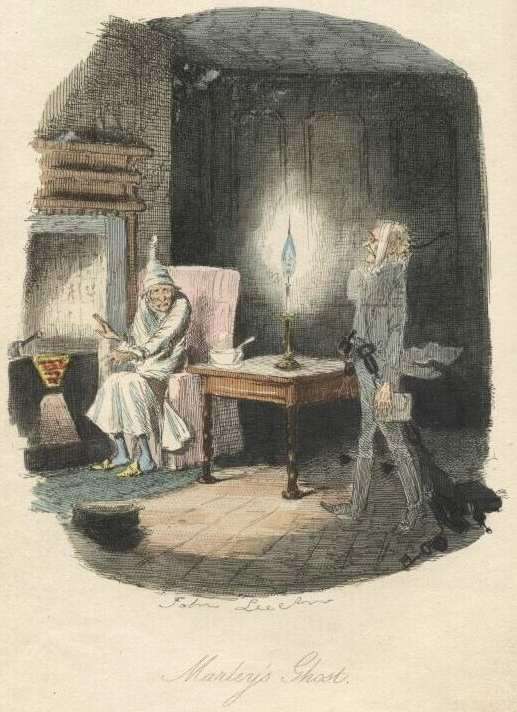
In the end of the tale, the latter view wins out, as Scrooge is converted. After the three ghosts, as well as his former partner, Marley, have done with him, Scrooge has been brought to a critical juncture where he sees the cruel consequences which have, and are, and will continue to result from his position. His hardness towards Christmas is actually a cover for his hardened heart towards his fellow men.

Charity

In fact, it is Scrooge’s hardened heart which disallows him to recognize the importance and good sense in charity. He is tight-fisted because he feels the poor do not deserve any better than their situation. He calls them “idle,” when asked to give to a charity which seeks to give food and drink to the poor for Christmas.

The theme of charity, or lack thereof, is furthermore presented in the person of Bob Crachit. Scrooge chastises Crachit for wanting to take the whole day off for Christmas, as Scrooge is still expected to pay Crachit for it. Scrooge sees it as an unfair expense, likening it to “pick[ing] a man’s pocket.”

Scrooge’s journey that night, however, takes him to the very people he was so quick to write off:

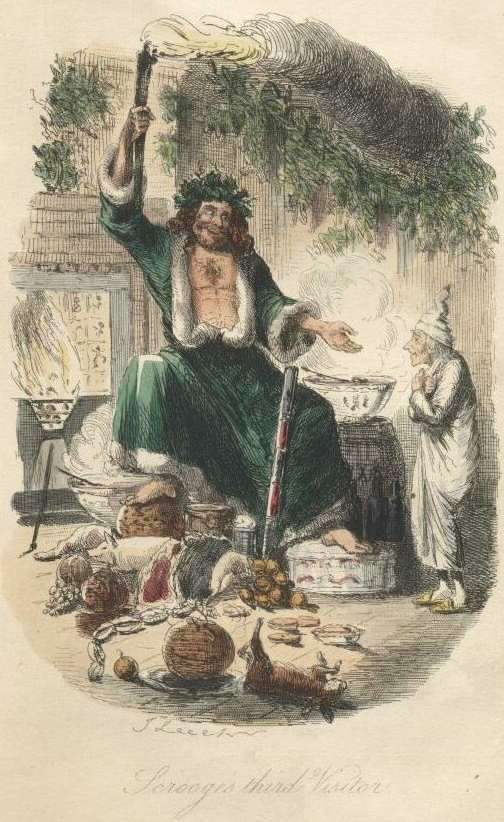
“The Spirit stood beside sick beds, and they were cheerful; on foreign lands, and they were close at home; by struggling men, and they were patient in their greater hope; by poverty, and it was rich. In almshouse, hospital, and jail, in misery’s every refuge, where vain man in his little brief authority had not made fast the door, and barred the Spirit out, he left his blessing, and taught Scrooge his precepts.”

The ghost of Christmas Present shows Scrooge the meaningfulness of charity and gives him practical tools for how to carry it out. At the end of the story, we see the result of this in his changed attitude and actions.

Illness and Death

A much more unpleasant, yet necessary theme is that of illness and death. Dickens makes sure his readers, along with Scrooge, see the results of poverty. Yet even Scrooge himself will not escape death, despite his wealth. Fred aptly states at the beginning of the book that all are “fellow-passengers to the grave.”

At the end of the tale, Scrooge is shown the sobering reality of this. He has already seen illness and death from the ghost of Christmas Present. Now he is shown his own death by the Ghost of Christmas Yet to Come, alone and friendless. Next, he sees the legacy he leaves. He is indirectly responsible for the death of Tiny Tim, whose father was not paid enough to get him the medical care he needs.

Fate

It is at this juncture, when he is shown such a dismal future, that the question of fate arises.  Can Scrooge change the destiny he is shown? Does showing it predetermine it?

Scrooge appeals to logic, for why would the Spirit show him the morose things of the future if he couldn’t change them?

Scrooge promises, “I will honour Christmas in my heart, and try to keep it all the year. I will live in the Past, the Present, and the Future. The Spirits of all Three shall strive within me. I will not shut out the lessons that they teach.”

He then pleads with the Spirit of Christmas Yet to Come, “Oh, tell me I may sponge away the writing on this stone!”

Transformation

This brings us to our happy ending and the final transformation of Scrooge. Our story concludes with good news:

“Scrooge was better than his word. He did it all, and infinitely more; and to Tiny Tim, who did not die, he was a second father. He became as good a friend, as good a master, and as good a man, as the good old city knew, or any other good old city, town, or borough, in the good old world.”

Scrooge does change his fate. He learns from what the Spirits taught him and does, indeed, keep Christmas in his heart. As we said before, this is not merely a jovial holiday spirit, but rather a disposition towards his fellow men: one of goodwill and charity. He adopts his nephew Fred’s ideology in the end.

I would argue it is a transformation instead of a redemption (a word people like to throw around when something good happens to a character), because although Scrooge’s overall disposition is altered, and one can certainly infer a change of heart beneath it, there is no mention that his positive outlook and good deeds somehow redeem his past. People do not forget the way he was. They simply, “laughed to see the alteration in him.”

In addition to this, he has not escaped his ultimate fate. Not to throw a damper on things, but he will still die, and as he is already an old man, it cannot be far off. His transformation means he is a changed man, but he is still a mortal, grave-bound man. The difference now is in his reputation and a much more pleasant, charitable ride passage to the grave.

On a Personal Note

This is a well-loved story, by myself and many others.

I was first introduced to it though the Muppet version as a child:

This version actually preserves the story quite well, bringing a good deal of humor and breaking of the fourth wall with it.

I remember enjoying Stanley and Waldorf as “the Marley Brothers,” and laughing immaturely with my siblings at Scrooge’s love interest, who flares her nostrils an excessive amount while singing, “When Love is Gone,” although for some reason this was cut from the newer version on most DVDs.

When I was older I was able to appreciate the storyline more. I even got to see a live play of it in high school.

I suffered through “Scrooge: the Musical,” at one point, being forced to watch Albert Finney dance and sing. And who could forget Bill Murray’s modern version, “Scrooged.”

This timeless tale is a classic for a reason, and it is one worth sharing with your family this Christmas.

Christmas Classics

Christmas is a great time of year to start talking about books!
 
I am excited to talk about some of my personal Christmas classics with you. Here’s a little sneak peek about what this will include in the month of December:
 
Each week I will post one blog about a Christmas classic, giving a little of the history behind it and covering some of the main themes.
 
I like to add a personal note at the end, sharing my memories of the piece of literature. This sometimes includes connecting it with adaptations and movie versions. I would love to hear about your memories and reflections, too!
 
Let’s dig in to some great Christmas classics together, starting with Dickens, of course.

click on one of these copies of A Christmas Carol to purchase on Amazon so you can read along!

A Brief Introduction

Let’s Talk Literature…

Hi! Welcome to my literature blog!

I am writing this blog in hopes that I might:

  1. Express my thoughts, reflections, and memories tied to literature. I tend to focus on themes, drawing on the history of the literary work.
  2. Provide a safe area for others to share their thoughts and memories on said literature.
  3. By providing the first two, to promote critical thinking and a feeling of shared experience around the literature discussed. Yay for literature!

I invite you to comment! I am interested to hear about your thoughts and reflections on these literary works. Please keep your comments appropriate and positive as much as possible.

About Me

I am a lover of good literature and sharing it with others. Literature has served as a great inspiration for me: stimulating critical and creative thought.

I am a writer. I started writing as a child and have continued into my adult years, gaining a BA in English to help me hone my skills. I am now a freelance creative writer and ghostwriter in my occupation.

I am not a literary expert. This blog is meant as a reflection of my thoughts, not as literary criticism (though some of my thoughts happen to fit in this category).

I write about books I like. I only write about books I am excited to share with others. I do not enjoy overly-critical, “I hate this book,” types of discussions.

You are entitled to that opinion if you hold it! I have chosen to make this blog primarily positive and celebratory of literature.

Design a site like this with WordPress.com
Get started