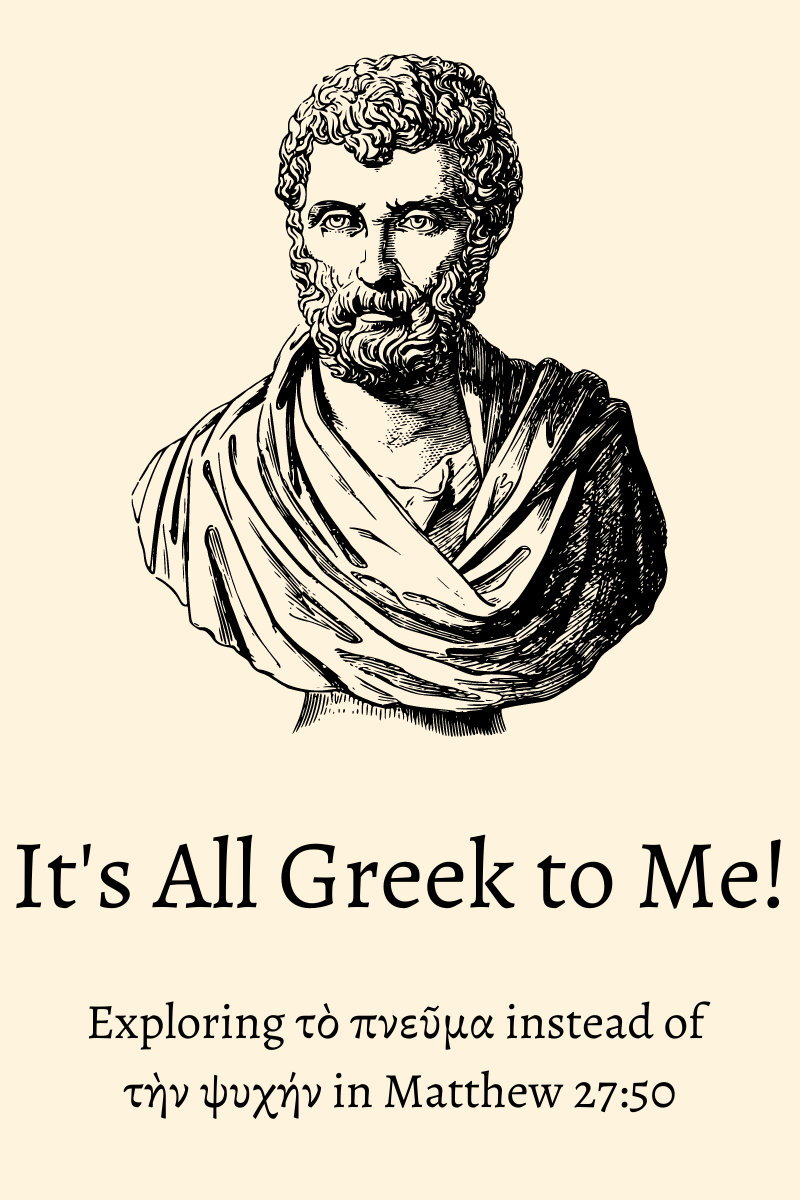
Let’s talk ancient Greek word studies on Good Friday :)

As I was reading through Matthew 26-27, about the events leading up to Jesus’ death, the verse, “Jesus cried again with a loud voice and yielded up his spirit” (27:50) stood out to me.

How did Jesus “yield his spirit?” I wondered. This prompted an investigation.

I looked up the verse in my Greek New Testament, then went to my Greek lexicon, then found some references of where this phrase occurs in other Greek texts. I thought I would share my findings with you.

Matthew 27:50 in the Greek:

ὁ δὲ Ἰησοῦς πάλιν κράξας φωνῇ μεγάλῃ ἀφῆκεν τὸ πνεῦμα.

It’s interesting to note that this is an unusual use of this phrase, compared with other Greek texts, as it substitutes τὸ πνεῦμα for τὴν ψυχήν.

Why τὸ πνεῦμα instead of τὴν ψυχήν?

πνεῦμα is often used in Matthew to mean the Holy Spirit, but it is also used in Matthew 12:43 to refer to an unclean spirit (demon), and when Jesus chastises his disciples for falling asleep in Matthew 26:41, saying their spirits are willing while their flesh is weak.

This word has a range of meanings, but in Matthew it just has two: (1) the Holy Spirit or (2) the spirit of a person or demon.

ψυχὴν, however, also occurs in Matthew. It means “soul” or “life” in these contexts.

In Matthew 2:20, it is used when the angel tells Joseph that, “those who sought the child’s life are dead,” referring to Herod and his men, who were trying to kill the baby Jesus.

In Matthew 10:28, however, it is used twice to mean “soul,” as Jesus tells his followers that though people might be able to kill their bodies for speaking on his behalf, they cannot kill their souls. Instead, they should fear the death of their soul (along with their body) in hell.

What is Matthew doing here?

What I infer from this is that Matthew may be using πνεῦμα to differentiate the death of Jesus from ordinary men. He wasn’t giving up an ordinary human spirit, as he was fully man and fully God.

I have to be careful here, because there are theological mysteries in Jesus’ death that are beyond my current knowledge and comprehension. I don’t want to simply read theology into the text here, either. Instead, I’ll use another scripture to help illuminate:

“I lay down my life that I might take it again. No man takes it from me, but I lay it down of myself. I have power to lay it down, and I have power to take it again.” John 10:17-18

Jesus predicted his death in all the gospels, but John’s gospel gives us an explicit explanation of the “how.”

Jesus is giving up His spirit, willingly and through his power. No one else caused him to die.

Jesus could have hung on the cross for days and then climbed off to show everyone his invulnerability. The irony in the mocking by the chief priests and elders (Matthew 27:42), that he “saved others,” and so why doesn’t he “save himself?” is that He could have.

Herodotus, The Histories 4.190

Here is an example of the phrase being used with τὴν ψυχήν in a Greek text from the late 400s BC:

θάπτουσι δὲ τοὺς ἀποθνήσκοντας οἱ νομάδες κατά περ οἱ Ἕλληνεςπλὴν Νασαμώνωνοὗτοι δε κατημένους θάπτουσιφυλάσσοντεςἐπεὰν ἀπιῇ τὴν ψυχήνὅκως μιν κατίσουσι μηδὲ ὕπτιος ἀποθανέεταιοἰκήματα δὲ σύμπηκτα ἐξ ἀνθερίκων ἐνειρμένων περὶ σχοίνους ἐστίκαὶ ταῦτα περιφορητάνόμοισι μὲν τοιούτοισι οὗτοι χρέωνται.

English Translation:

The dead are buried by the nomads in Greek fashion, except by the Nasamones. They bury their dead sitting, being careful to make the dying man sit when he releases his spirit, and not die lying supine. Their dwellings are constructed of asphodel stalks1 twined about reeds; they can be carried here and there. Such are the Libyan customs.

1 Asphodel is a long-stalked plant. The name has acquired picturesque associations; but Homer’s “asphodel meadow” is in the unhappy realm of the dead, and is intended clearly to indicate a place of rank weeds.

***Texts above from Perseus.tufts.edu

1 Esdras 4.21

Here is an example from the greek Aprocryphal book of 1 Esdras (possibly from 2nd Century BC):

21 καὶ μετὰ τῆς γυναικὸς ἀφίησι τὴν ψυχὴν καὶ οὔτε τὸν πατέρα μέμνηται οὔτε τὴν μητέρα οὔτε τὴν χώραν

English Translation: (CEB Biblegateway)

21 With his wife he departs this life, with no memory of his father or mother or country.

Greek Septuagint, Genesis 35:18

This passage is talking about Rachel, one of Jacob’s wives and the mother to Joseph and Benjamin. She is dying in childbirth, after bearing Benjamin, and the phrase is used to signal that her soul is moving on.

ἐγένετο δὲ ἐν τῷ ἀφιέναι αὐτὴν τὴν ψυχήν— ἀπέθνῃσκεν γάρ— ἐκάλεσεν τὸ ὄνομα αὐτοῦ Υἱὸς ὀδύνης μου· ὁ δὲ πατὴρ ἐκάλεσεν αὐτὸν Βενιαμιν.

ESV English Translation:

And as her soul was departing, for she was dying, she called his name Ben-oni but his father called him Benjamin.

Application:

Matthew arguably could have had this phrase in mind from these texts, or rather simply known the ordinary Greek usage of it. Therefore, I think there is a purposeful use of τὸ πνεῦμα.

The fact that Jesus gave up his spirit when he didn’t have to shows His dedication to the purpose the Father had for Him and His desire to save us.

We should mourn what Jesus had to suffer, but we can also see His sacrificial love. Praise God for the gift He has given us, and the price He was willing to pay so that we could be with Him!

Also, here’s my one-verse meditation on John 19:30 for Good Friday from my Youtube channel:

Quarterly Goals Check-in

Do you have 2021 goals you are working towards? How are you doing?

I tried to break my 2021 goals into quarterly and weekly tasks, to make them more manageable. Admittedly, I don’t always meet them within the allotted time frame, but I have made great progress!

Here are a few of my goals and my quarterly progress. I like to grade myself on a scale of 1 to 10, giving myself grace for factors I can’t control.

  1. Blog 3X per week. 10 out of 10! I only did 2 one week, but I made up for it by doing 4 another week. I’ve had to get more flexible about what I write and a little looser with the grammar to accomplish this.
  2. Freelance income. Eh, 7 out of 10, with a grace factor. I was too lofty in my goal, and forgot that a large part of this depends on how much work my clients have for me. A couple of my clients went radio silent in the new year, and others have work “down the pipeline” but had to get organized in the first couple of months. I have sought new clients like a champ, but for whatever reason, there have been less bites. Things have started to pick back up, which I am thankful for. One of the downsides to freelance work is the ebb and flow. Last year, I made the most/ was the busiest over the summer months. Also, the plus side is that I’ve had much more time for my writing/ publishing projects!
  3. Stay healthy. 10 out of 10. I’ve kept a regular exercise bike/ yoga/ cardio/ strength training routine and eaten lots of fresh fruits and vegetables. Right now, I am gluten-free, dairy-free, and almost meat-free. Yet, my UC has flared up! Autoimmune disorders – What can you do?
  4. Read 25 “texts.” 10 out of 10. These could be anything from poems to myths to short stories or novels. I’ve mentioned about 19 of these in my blogs, and truthfully I read more than I blog about. I don’t count Bible commentaries, books of the Bible, or blogs/ articles in this. If I had to guess, I’ve probably made my mark, but I need a better system to keep track of it.
  5. Post 1 Bible for the Busy Woman video/ week. 10 out of 10! This has been a fun project, and I feel I’ve grown not just in my Bible knowledge and in thinking about how to communicate about spiritual things, but also in filming and editing and using Youtube. You can check out these videos on my Youtube channel here.
  6. Grow in gratitude and give thanks to God daily. 7 out of 10. It’s definitely been a struggle, but I’ve tried very hard to give thanks even when I don’t feel well and while Chicago is still mostly locked down.
  7. Let go and give more to God. 5 out of 10. Man, I love to hold on to things and try to control things ! I’m still working on this one, but I have moments where I’m able to let go and find peace.
  8. Learn how to deal better with conflict. 2 out of 10. I honestly forgot about this one, which is probably a signal that I am ignoring my conflicted feelings about dealing with conflict, haha! I’ll have to actively seek out some resources and tools for this. If you have recommendations, I’m all ears!
  9. Finish editing The Land in the Woods. 10 out of 10. I finished and incorporated all feedback, then decided I would just “read it through.” I found myself making so many changes that I decided to do a fourth round of full editing! This is my debut self-published book, so I want it to be amazing! Stay tuned for a cover reveal.
  10. Finish writing the first draft of The Forgotten Scroll. 9 out of 10. This is the sequel to The Land in the Woods. I made it to the last 2 chapters, but I really psych myself out about endings. I plan to finish it this week, but we’ll see.
  11. Stay in touch with friends more. 9 out of 10. I’ve gotten much better at this! It’s harder to say “let’s hang out” when you can only meet virtually, but I’ve tried to make it a priority. I’ve been doing multiple virtual meet-ups or phone calls with friends every week!

I have at least 8 more goals, but I won’t bore you with all the details, and some are more private. At least one of them I have partly given up (studying German) because we are no longer going to Germany. However, I may pick it up again if I have some time and energy to do so over the summer.

What about you? How is your year going so far? Are there goals you are crushing or have had to let go of?

Celebrating Holy Week

Happy Palm Sunday!

I will be doing a two-minute reflection/ meditation on one Bible verse each day this week.

You can subscribe to my Youtube channel if you want to follow along! I will not be posting all those videos on my blog.

Why do Christians celebrate Palm Sunday?

The Biblical accounts are found in:

According to some sources, the first palm processional to honor this Biblical account might have taken place in the fourth century.

Basically, today Christians use palm branches to remember when Jesus entered into Jerusalem, the week he would be crucified. He was given a royal welcome, with people shouting “Hosanna!” and “Blessed is He who comes in the name of the Lord!”

In the video, I discuss the fulfillment of the prophecy in Zechariah 9:9-

Rejoice greatly, O daughter of Zion!
    Shout aloud, O daughter of Jerusalem!
Behold, your king is coming to you;
    righteous and having salvation is he,
humble and mounted on a donkey,
    on a colt, the foal of a donkey.

ESV Bible, Zechariah 9:9

Jesus had been teaching and healing people, and had amassed quite a reputation and following. He was received with hope, as people saw Him as a deliverer from their present troubles, especially the oppressive Roman rule.

Yet, Jesus would not deliver them in the way they had anticipated, and though Palm Sunday is often seen a celebratory it is also the beginning of a grim and dark week.

E. Nesbit’s The Phoenix and the Carpet

Paperback The Phoenix and the Carpet Book

I absolutely loved this book!

The interactions between the children were just as good as the first book in this series (the Psammead series: Five Children and It is the first book).

I loved the Phoenix. He had a delightful, wise, interesting and unique personality. This really shines through in the dialogue.

Here’s an excerpt from when they first meet him:

‘Well,’ said the Phoenix, seeming on the whole rather flattered, ‘to cut about seventy long stories short (though I had to listen to them all – but to be sure in the wilderness there is plenty of time), this prince and princess were so fond of each other that they did not want any one else, and the enchanter – don’t be alarmed, I won’t go into his history – had given them a magic carpet (you’ve heard of a magic carpet?), and they had just sat on it and told it to take them right away from everyone – and it had brought them to the wilderness. And as they meant to stay there they had no further use for the carpet, so they gave it to me. That was indeed the chance of a lifetime!’

‘I don’t see what you wanted with a carpet,’ said Jane, ‘when you’ve got those lovely wings.’

‘They are nice wings, aren’t they?’ said the Phoenix, simpering and spreading them out. ‘Well, I got the prince to lay out the carpet, and I laid my egg on it; then I said to the carpet, “Now, my excellent carpet, prove your worth. Take that egg somewhere where it can’t be hatched for two thousand years, and where, when that time’s up, someone will light a fire of sweet wood and aromatic gums, and put the egg in to hatch;” and you see it’s all come out exactly as I said. The words were no sooner out of my beak than egg and carpet disappeared. The royal lovers assisted to arrange my pile, and soothed my last moments. I burnt myself up and knew no more till I awoke on yonder altar.’

Nesbit, Edith. EDITH NESBIT Ultimate Collection: 20 Novels & 200+ Short Stories, Tales for Children & Poems (Illustrated): The Railway Children, The Enchanted Castle, … Beautiful Stories from Shakespeare… . e-artnow. Kindle Edition.

The Phoenix explains in entertaining detail how he came to be in the form of an egg, and reveals to the children that the new carpet in their bedroom is magical. It can take them anywhere they want!

Thus the adventures begin.

The children soon start wishing to go places, and go on many grand adventures.

Nesbit introduces an interesting concept in this story, however. The children learn not only about adventure, but about right and wrong. Robert and Cyril are noted to have an “inward monitor” at times, that tells him to do kind things, and not unkind or selfish things.

Jane, who has a soft heart, takes pity on a burglar and finds out that he isn’t the cruel stereotype that she imagined. In other words, the children have started to learn about how to treat others kindly.

The children learn more about looking out for each other, and have grown wiser about using magic from their experience with the Psammead in the last book (which always had negative outcomes).

In this book, the children also have a wise guide, who sometimes uses his magic to help the children. The Phoenix knows about different kinds of magic, and can communicate with other magical beings, such as the carpet.

When the children use up all their carpet wishes and can’t get home, the Phoenix finds out from the carpet where he can go to help them:

‘But how did you do it?’ they asked, when everyone had thanked the Phoenix again and again.

‘Oh, I just went and got a wish from your friend the Psammead.’

‘But how did you know where to find it?’

‘I found that out from the carpet; these wishing creatures always know all about each other – they’re so clannish; like the Scots, you know – all related.’

Nesbit, Edith. EDITH NESBIT Ultimate Collection: 20 Novels & 200+ Short Stories, Tales for Children & Poems (Illustrated): The Railway Children, The Enchanted Castle, … Beautiful Stories from Shakespeare… . e-artnow. Kindle Edition.

The magic in this story is fun, and mostly just involves transportation. The children have a blast exploring old castles, finding hidden treasure, and taking their cook to a tropical island (where she chooses to stay).

The carpet brings them things, too. When they ask it to bring them something from its homeland, it reappears with 100 mewing Persian cats. It also thought to bring 100 rats for them to snack on, which the children promptly say to take away. Instead, they ask the carpet to bring enough milk for the cats, and it brings a cow.

The fun has to end, however, and the Phoenix and the carpet eventually move on.

There’s humor, adventure, and fun interchanges between the characters. I highly recommend this fun, classic, middle-grade children’s fantasy read!

Below is the first episode of the 1997 BBC version, and the audiobook.

Bible For the Busy Woman: The Beatitudes, Part II

Last week, we talked about what Jesus means when he says blessed are the poor in spirit, mournful, and meek.

Today, we’re going to go through the final 5 beatitudes:

  • those who hunger and thirst for righteousness
  • the merciful
  • the pure in heart
  • the peacemakers
  • those persecuted for righteousness/ Christ

Watch the video to find out what these mean! And please subscribe, like, and comment on my Youtube channel 🙂

Resources used for this video:

  • Zondervan Illustrated Bible Backgrounds Commentary, Vol. 1: Matthew, Mark, Luke. Edited by Clinton E. Arnold. 2002.
  • IVP Dictionary of Jesus and the Gospels. Editors Joel B. Green, Scot McKnight, I. Howard Marshall. 1992.
  • Greek New Testament

Bible for the Busy Woman is for:

  • mothers of young children who can only grab a few minutes and don’t have a lot of brain power
  • working women who have to give a lot to their job and want to understand the Bible better but don’t have the time
  • female students who need their brainpower for their studies

Goals:

  • Help women to be in the Word regularly.
  • Help women gain understanding of proper approaches to studying the Bible.
  • Educate women about books of the Bible and connections throughout the Bible.
  • Teach orthodox theology according to the Bible.
  • Encourage women to live for God.

I hold a BA in English and an MA in Theological Studies. Additionally, I have taught the Bible while working in various ministries for over ten years. I love helping others understand God’s Word and how to live for him.

Please let me know if you have any questions about the Bible passage, Christianity, theology, etc. I’d love to answer them or point you to some resources!

The Lazy Scholar

In my experience, there are three main types of readers:

  1. The Sprinter: the one who reads quickly, but doesn’t fully understand because they either don’t care or don’t have time.
  2. The Savant: the one who reads slowly and methodically, memorizing every detail and arriving at the deepest understanding possible.
  3. The Lazy Scholar: the one who reads quickly and actively, gaining a deeper understanding than sprinters.

I’ve always been the lazy scholar. Though “lazy” has negative connotations, I’ve found that it can motivate me to be more efficient.

Why I’m a Lazy Scholar

The first time I read something, I take notes or select quotes. I read it slow enough to process, while skimming slower and less important parts.

I read a little slower than the sprinters, who rush through books and might have to go back to them to understand them, and a little faster than the methodical, obsessive readers who believe every word counts.

This method has helped me through my degrees and with this blog. When write about a book or work, I’ve essentially already started to analyze it. Sometimes, I get to the end of the book and have a little more work to do.

Active Reading

I have always been an active reader. Physically, I move around quite a bit when I read. I take breaks and get up every so often just to move around. This actually helps with blood flow, helping my brain to be more oxygenated and thus enabling me to better think about what I’m reading.

Sometimes I take handwritten notes, which could be as vague as a few words and a page number, or I’ll copy and paste quotes if it’s in Kindle. I’ve learned not to overdo it with the notes, as that will slow down the reading quite a bit.

I’ve made a rule that I only take a note on something if I think it might be important. It takes time to develop this judgment, and what’s important will change based on what kind of text you’re reading. At my active reading speed, I can average about 3 minutes per page (unless it’s dense philosophy or something super technical).

Speed Reading

I’ll be honest: I’ve never been a speed reader, but I do occasionally use speed reading as a tool when needed.

For example, if the book is giving more basic information or has a very simple plot line and thin prose, then I can skim and get the main points. I tend to read about 40 seconds- 1 minute per page (250-300 words) when I’m speed reading.

I admire the sprinters for their speed, but I know that I wouldn’t be satisfied with reading at that pace on a regular basis. Like I said, I only do that when needed and necessary, but I think it’s essential for people who are studying at times (We all know that teacher who assigns 400 pages per week!).

Why I’m Not a Savant

I deeply admire the savants and their dedication to understanding all the particulars of a text. Yet, I’ve found I’m interested in learning so many different things that I wouldn’t be content to spend days on end on a single text or subject.

Maybe it’s my creative spirit or my extraversion, but I am compelled to continually move on to the next great literary treasure.

What about you? Which type do you lean toward? Or maybe you’re one I’ve not listed!

Spring Fever

I am thrilled that the first day of spring is finally here!

Gone “is the winter of our discontent made glorious summer by this sun” of Chicago spring! (Shakespeare, Richard III)

I don’t know about you, but the spring fever is upon me. I’ve begun spring cleaning, and will soon change over my wardrobe (finger’s crossed that the snow is gone for good!).

Here are some spring poems to enjoy as we watch the flowers and leaves start to bud and bloom:

The Spring

Thomas Carew

Now that the winter’s gone, the earth hath lost
Her snow-white robes, and now no more the frost
Candies the grass, or casts an icy cream
Upon the silver lake or crystal stream;
But the warm sun thaws the benumbed earth,
And makes it tender; gives a sacred birth
To the dead swallow; wakes in hollow tree
The drowsy cuckoo, and the humble-bee.
Now do a choir of chirping minstrels bring
In triumph to the world the youthful Spring.
The valleys, hills, and woods in rich array
Welcome the coming of the long’d-for May.
Now all things smile, only my love doth lour;
Nor hath the scalding noonday sun the power
To melt that marble ice, which still doth hold
Her heart congeal’d, and makes her pity cold.
The ox, which lately did for shelter fly
Into the stall, doth now securely lie
In open fields; and love no more is made
By the fireside, but in the cooler shade
Amyntas now doth with his Chloris sleep
Under a sycamore, and all things keep
Time with the season; only she doth carry
June in her eyes, in her heart January.

(from: https://www.poetryfoundation.org/poems/43881/the-spring-56d222c1918e0)

Song: Spring

 (from Love’s Labours Lost, by William Shakespeare)

When daisies pied and violets blue
   And lady-smocks all silver-white
And cuckoo-buds of yellow hue
   Do paint the meadows with delight,
The cuckoo then, on every tree,
Mocks married men; for thus sings he,
                         Cuckoo;
Cuckoo, cuckoo: Oh word of fear,
Unpleasing to a married ear!

When shepherds pipe on oaten straws,
   And merry larks are plowmen’s clocks,
When turtles tread, and rooks, and daws,
   And maidens bleach their summer smocks,
The cuckoo then, on every tree,
Mocks married men; for thus sings he,
                         Cuckoo;
Cuckoo, cuckoo: Oh word of fear,
Unpleasing to a married ear!

(from: https://www.poetryfoundation.org/poems/51781/spring-56d22fc0d9dca)

Lines Written in Early Spring

William Wordsworth

I heard a thousand blended notes,
While in a grove I sate reclined,
In that sweet mood when pleasant thoughts
Bring sad thoughts to the mind.

To her fair works did Nature link
The human soul that through me ran;
And much it grieved my heart to think
What man has made of man.

Through primrose tufts, in that green bower,
The periwinkle trailed its wreaths;
And ’tis my faith that every flower
Enjoys the air it breathes.

The birds around me hopped and played,
Their thoughts I cannot measure:—
But the least motion which they made
It seemed a thrill of pleasure.

The budding twigs spread out their fan,
To catch the breezy air;
And I must think, do all I can,
That there was pleasure there.

If this belief from heaven be sent,
If such be Nature’s holy plan,
Have I not reason to lament
What man has made of man?

(from: https://www.poetryfoundation.org/poems/51001/lines-written-in-early-spring)

Bible for the Busy Woman The Beatitudes, Part 1

We all know the beatitudes, but what do they mean?

In this week’s video, we look at the first 3 beatitudes in-depth and use the Biblical and historical context to help us understand why Jesus started teaching his followers this way.

Welcome to Bible for the Busy Woman!

I hold a BA in English and an MA in Theological Studies. Additionally, I have taught the Bible while working in various ministries for over ten years. I love helping others understand God’s Word and how to live for him.

Subscribe to my Youtube channel to join me for these quick, 5-minute, information-rich devotionals, which I post every Friday.

Resources used for this video:

Zondervan Illustrated Bible Backgrounds Commentary, Vol. 1: Matthew, Mark, Luke. Edited by Clinton E. Arnold. 2002.

IVP Dictionary of Jesus and the Gospels. Editors Joel B. Green, Scot McKnight, I. Howard Marshall. 1992.

Greek New Testament

Think you don’t have time to study the Bible? Let these videos help enhance your understanding as you read through these Bible passages. Feel free to ask me some questions and I’ll direct you to some helpful resources.

Goals:

  • Help women to be in the Word regularly.
  • Help women gain understanding of proper approaches to studying the Bible.
  • Educate women about books of the Bible and connections throughout the Bible.
  • Teach orthodox theology according to the Bible.
  • Encourage women to live for God.

Bible for the Busy Woman is for:

  • mothers of young children who can only grab a few minutes and don’t have a lot of brain power
  • working women who have to give a lot to their job and want to understand the Bible better but don’t have the time
  • female students who need their brainpower for their studies

Atrahasis: A Babylonian Creation Myth

Image from https://britishmuseum.withgoogle.com/object/cuneiform-tablet-with-the-atrahasis-epic

As my church is reading through Genesis, I’ve been looking at commentaries and studying the passages in depth. The Word Biblical Commentary mentions many of the other creation myths that would have been well-known at the time Genesis was written, and can therefore provide some context for understanding style and motifs in the Genesis account.

I’m not saying that Genesis is simply a literary text. To me, it is also the authoritative word of God. However, it is a text, and was written in a cultural and literary environment, and thus I find it fruitful to take a look at what some of the texts in that literary environment were.

What is Atrahasis about?

This brings me to Atrahasis. This Old Babylonian myth begins at a time before man is created, like the Genesis account. However, in Atrahasis there are many gods. In fact, there are so many you’ll have to reference dictionaries on Babylonian gods along the way to keep track of them and to understand their roles.

At the beginning of Atrahasis, the great Anunna-gods are burdening the lesser Igigi-gods with forced labor. The god Anu is king, the warrior god Enlil is counsellor, and Ninurta is prefect.

The gods cast lots (kind of like drawing straws). The result is that Anu gets to govern the heavens while Enlil will govern the earth. Anu goes up there, and Enlil oversees the Igigi-gods and their forced labor.

As you might guess, the Igigi-gods get tired of working, so they come up with a plan: they will fight Enlil so that they can be free from their heavy work.

When the Igigi-gods surround Enlil’s dwelling, he sends for the other Anunna-gods. Then, he goes out to debate the Igigi-gods.

Here, you can already see a difference in the Genesis account (if you know it). In Genesis, there is only one God. The emphasis on God’s oneness throughout the Pentateuch radically sets Judaism apart from the pagan religions and their myths.

How Man is Created

In Genesis, God creates man from dirt, but then breathes life into him. Mankind is created in the image of God, to rule over His creation.

In Atrahasis, mankind is created by killing one of the gods and mixing his blood with dirt.

“Let one god be slaughtered,

Then let the gods be purified in it.

Let Nintu mix clay with his flesh and blood,

Let that same god and man be thoroughly mixed in the clay”

Foster, Benjamin R. Before the Muses: An Anthology of Akkadian Literature. 2005. Lines 208-211.

Then, they slaughter Aw-ila, the god who had this inspiration, and the Igigi gods spit on the clay. Mami, the birth goddess, helps to remove the work from the Igigi gods and put it on the shoulders of mankind instead.

This has panentheistic undertones, as a god becomes part of the creation. The spirit of the god used to create mankind now becomes mankind’s spirit.

After this point, the version I was reading talks about fertility and the first childbirth, where Nintu (which is possibly another name for Mami) is the midwife.

In both accounts of creation, man is created to work. In Genesis, however, mankind is blessed to rule over creation and work the ground. He is given a good and prestigious position. In Atrahasis, mankind is burdened with the work the gods don’t want to do.

Where Did Atrahasis Come from?

I read an English translation by Benjamin R. Foster of the Old Babylonian version, which is based on a manuscript dating back to 1700 B.C.

Some other fragments were found and incorporated, but there are also missing parts to the story. The original version was three tablets of 1245 lines, of which we only have about 60%.1

A scribal identification on the three tablets can be connected with the time and rule of Ammi-Saduqa, the great-grandson of Hammurabi. He would have ruled in Babylon, which is modern day Iraq.2 

Sources:

  1. Foster, Benjamin R. Before the Muses: An Anthology of Akkadian Literature. 2005.
  2. “Atra-Hasis.” New World Encyclopedia. https://www.newworldencyclopedia.org/entry/Atra-Hasis

You can find an audio background and brief explanation of this text here:

https://britishmuseum.withgoogle.com/object/cuneiform-tablet-with-the-atrahasis-epic

The Shadows by George MacDonald

This is one of George MacDonald’s stranger tales. It is a fairytale of sorts, but also reads a little like a ghost story.

Throughout the story, I was trying to guess what the shadows were. The tricky thing is, not even the shadows seemed to know that.

The King of Fairyland Meets the Shadows

The story opens with the mortal king of fairyland, who is sick in his bed in London. MacDonald has this tongue-in-cheek way of adding irrelevant details which defy normal fairytale conventions:

Old Ralph Rinkelmann made his living by comic sketches, and all but lost it again by tragic poems. So he was just the man to be chosen king
of the fairies, for in Fairyland the sovereignty is elective.

The king meets some mischievous shadows when they start dancing on his wall and playing mind games with him. They claim to be his subjects, and tell him they want him to know them better.

Intrigued, the King asks to know more about them. They take him on a journey to their shadowland (which is in Iceland, naturally), where the aurora borealis is visible. There, they go to “church” before going about their night business.

In Shadowland

The king has never seen anything like the shadows:

The king had seen all kind of gnomes, goblins, and kobolds at his coronation; but they were quite rectilinear figures compared with the insane lawlessness of form in which the Shadows rejoiced; and the wildest gambols of the former were orderly dances of ceremony beside the apparently aimless and willful contortions of figure, and metamorphoses of shape, in which the latter indulged.

They retained, however, all the time, to the surprise of the king, an identity, each of his own type, inexplicably perceptible through every change. Indeed this preservation of the primary idea of each form was more wonderful than the bewildering and ridiculous alterations to which the form itself was every moment subjected.

From there, the king continues to try to understand what the shadows are. They claim they are “human Shadows,” but beyond that they don’t offer a concrete explanation.

The King meets many of the shadows and they regale him with stories of their exploits around the world. MacDonald raises many interesting moral, philosophical, and sociological points through these stories.

What Are the Shadows?

We learn a few things about the shadows:

  1. They are impish and like to play tricks on people.
  2. They try to point humans towards behaving better, or punish them for behaving badly (though only by frightening them or making them feel guilt).
  3. They can only come out at night.
  4. They are not human, but they can become human if they stay out too long.
  5. They only remember what happens each night, but have no recollection of the previous nights.
  6. They are not angels, as angels are spoken of as other kinds of beings.

Do you have any guesses of what the shadows might be?

At first, I thought the shadows were ghosts, but it turned out they had never been human. Then, I thought they were angels.

I finally surmised they are ambiguous beings who “haunt” humans. Perhaps they can be compared to the “angel and demon on the shoulder” idea, as they try to influence human behavior.

Literary Connections

This story definitely brought to mind Peter Pan’s relationship with his shadow. I am sure that J.M. Barrie was influenced by MacDonald, whose stories were well-known by that time.

If you want to see a deeper analysis, here’s an interesting article I found on this story: http://www.george-macdonald.com/resources1/the_shadows.html

You can read The Shadows for free on Project Gutenberg: http://www.gutenberg.org/ebooks/18859

Design a site like this with WordPress.com
Get started