Here are a few fun facts about St. Valentine, after whom the holiday is named:
There are a couple of historical candidates who may have earned the name St. Valentine, but we’re not certain. One of them was a martyr.
The celebration of Valentine’s Day as a day for couples started in the 14th Century.
In the Catholic church, St. Valentine was the saint of marriage, beekeepers, and epilepsy.
Chaucer may have been to blame for the start of this holiday, as it first appeared in “Parliament of Foules,” which I will share an excerpt from:
For this was on Seynt Valentynes day, Whan every foul cometh ther to chese his make, Of every kinde, that men thynke may; And that so huge a noyse gan they make, That erthe and see, and tree, and every lake So ful was, that unnethe was ther space For me to stonde, so ful was al the place.
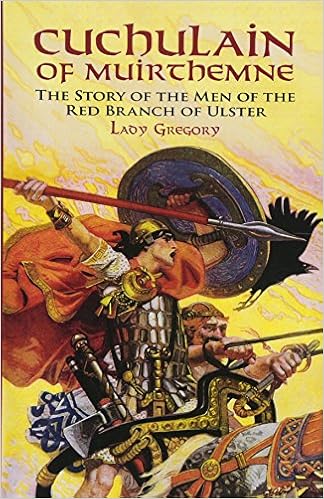
This is a different telling of the stories than I read, but it is much cheaper on Amazon.
When I was studying abroad in Ireland during my senior year of undergrad, I had the privilege of taking an Irish mythology course. In it, I was introduced to Irish greats like Cú Chulainn and Fionn mac Cumhaill (Finn McCool).
I didn’t read them in Gaelic, although I have a deep appreciation for the language.
After many years, I dug up my Longman anthology of British Literature from the Middle Ages and was surprised to see Cú Chulainn there. Here’s my take on the short stories I read about him, as well as a little more background on the myths if you’re interested.
Where Did These Stories Come From?
Many accounts say the stories were passed down by oral tradition during the first few centuries until they were written down, but there is some disagreement about the dates.
As the stories go, Cú Chulainn was a hero of Ulster around the 1st Century. It stands to reason that the tales must have started after that point, but I believe there is no written evidence of them until at least the seventh century.
Cú Chulainn is referred to a different name (Setanta is his given name at birth in many) or alternative spellings (Cú Chulaind) as well, which adds to the confusion. Part of this is because he is renamed based on his deeds, as you will see in one of the tales below.
The Birth of Cú Chulainn
This is a very strange birth story. The tale opens with a legendary king of the Ulsterman, Conchobor, in his chariot with his daughter Deichtine. The land is devastated, and he and his men are driving chariots to chase away the birds. The birds fly and sing, enchanting the men. If I had to guess, they have something to do with what happens next.
The birds leave, it snows, and all the men seek shelter. In the shelter, the wife of the man of the house is giving birth. Deichtine kindly goes to help her. A boy is born, and at the same time, a mare at the entrance to the house gives birth to two foals.
The foals are given to the boy and Deichtine nurses him. In the morning, however, everything vanishes: the man, his wife, and the house. Conchobor, his daughter, and his men are left to care for the baby boy and the two foals.
Then, the boy dies. Deichtine cries for a while and then she turns to drinking, but a strange creature appears every time she tries to drink and prevents her from doing so. She has a strange dream about Lug, a pre-Christian deity in Ireland, who says she’s in his house and is now pregnant with his son. He will be named Setanta (Cú Chulainn’s original name).
Deichtine becomes pregnant, and no one knows who the father is. Conchobar’s men guess that it was him when he was drunk, and Conchobar then marries his daughter off to this guy, Súaltam. Deichtine is so embarrassed at being pregnant that she crushes the child within her and a split second later is pregnant by Súaltam. Súaltam is credited, in other accounts, as being the mortal father of Cú Chulainn.
My question is: at what point is Cú Chulainn born here?
As I recall, there are many different birth stories of Cú Chulainn, and the possibility that he was born more than once. If I had to guess, I would say Cú Chulainn was killed before he was born but was so clever or strong or something that he figures out how to be born again at a later time. This is mythology, so anything is game.
The Naming of Cú Chulainn
In this story, things are a little more straightforward. Cú Chulainn wins a bunch of games against all the other boys and ends up stripping them stark naked and humiliating them. There are many double entendres in this story about balls and sticks that are used in a game, but basically the point is that Cú Chulainn is the strongest and most manly.
Then, when Cú Chulainn is invited to Culann’s house for a feast, Conchobar forgets that Cú Chulainn is coming and tells Culann that everyone is there. Culann lets out his giant watchdog and it attacks Cú Chulainn while he is still playing.
The men of Ulster try to assist Cú Chulainn, but the boy outsmarts and overpowers the hound. When Culann finds out his watchdog has been killed, he laments, but Cú Chulainn offers to serve in place of the watchdog until a new one can be reared.
Thus, he is called Cú Chulainn, which means “hound of Culann.” It’s a pretty cool origin story.
Literary Connections
There are many connections between stories of Cú Chulainn and earlier mythology. Some have cited Hercules, as he is also a strong demigod character.
However, if you go back further, there are some parallels with the Sumerian Epic of Gilgamesh (dates around 2000BC).
Gilgamesh plays similar games with the young men of the town and shows his male prowess and strength. My husband (who studies ancient mythology) tells me there’s a story of of the Anzu bird being killed, and the one who kills it (Ningurzu, but this is also attributed to Marduk) becomes known for that, and names a temple after it. The connection is the association of the name of the creature that is killed with the person who killed it.
Other Resources:
Here’s a cool blog I stumbled across that does a good job telling some highlights of Cú Chulainn’s life:
Today’s video is about Matthew 3:1-12. It introduces John the Baptist, a relative and forerunner to Jesus. You’ll hear the importance of his message of repentance in preparing people for Jesus.
I post a new video every Monday- subscribe on Youtube and hit the notifications bell for a reminder.
Here’s some interesting background material that I had to cut from the video because it was too long:
Baptisms and Washings
The John’s baptism is not the same as we think of baptism today. At the time, there was a community of religious people, the Qumran, who thought the religious teachers were impure, and so they avoided the temple and practiced their own cleansing “washings.” It’s possible that John was formerly part of this group or at least influenced by them, as he was in the same area.
The Pharisees practiced washings, too. John’s baptism was different from the Pharisees’ washings in that the focus was on inward repentance and cleansing, instead of just the outer cleansing.
The Pharisees and Sadducees
The Pharisees
Held to Torah, but also highly valued scribal interpretation of it. The interpretation usually had many specific rules and rituals to follow.
Obeyed oral traditions, too.
Believed in angels and spiritual beings.
Were expecting a Messiah to overthrow Gentile rulers and restore the nation of Israel.
Believed in the resurrection of the righteous.
The Sadducees
Believed only the Torah was authoritative
Denied spiritual beings/ life
Denied resurrection from the dead
Did not expect a Messiah
Were more open to Hellenism
Were more aristocratic than the pharisees
***these two groups of teachers will play an important role throughout Jesus’ ministry, death, and resurrection.
In today’s text, John calls them vipers because, like the serpent in the Garden of Eden, they are leading others astray with half truths about God’s Word.
Winnowing
Wheat on the threshing floor would be tossed with a winnowing fork, and the wind would blow away the lighter, impure “chaff” that they wouldn’t want to be in the flour. It was scattered by the wind because it was unfit and useless, and the heavier, good parts of the wheat would fall to the ground.
In today’s passage, John is saying you want to be the good wheat (repentant) and not the chaff (unrepentant).
Also, here’s a bad joke:
Q: Why did the other teachers of the law run away and refuse to talk to the Pharisees?
A: Because they were “sad,” u see?
Sources: Zondervan Illustrated Bible Backgrounds Commentary, Vol. 1: Matthew, Mark, Luke. Edited by Clinton E. Arnold. 2002.
IVP Dictionary of Jesus and the Gospels. Editors Joel B. Green, Scot McKnight, I. Howard Marshall. 1992.
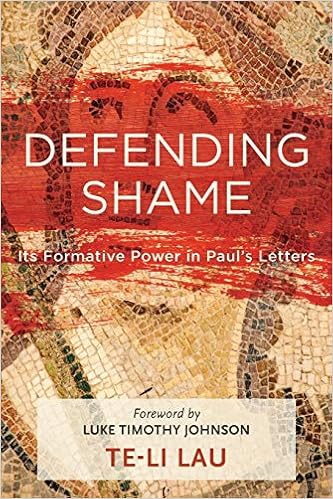
I really enjoyed reading this book by Dr. Te-Li Lau, my former Greek exegesis professor at Trinity Evangelical Divinity School. I appreciated the amount of scholarship and wisdom he brought to the current debates surrounding shame.
First, this is a Christian book with a scholarly approach to the subject of shame and Paul’s letters, so it’s not for everyone. It helped me think about shame from a more Biblical and godly perspective, and I want to share some of my findings here. Below are a few of my take-aways.
Not all shame is bad.
Lau quotes the popular Brene Brown, who says, “shame is lethal” or “destructive,” pointing out the current trend to view shame as something evil.
My own opinion is that shame, like other emotions, is neither good nor bad, but that it depends what is eliciting this response in us. Is it bad for me to feel shame if I slap an old lady in the face? No. Is it bad for me to feel shame for something that is not wrong? Probably.
There are two kinds of shame: the debilitating shame that we feel when we mistakenly think we’ve done wrong, and the good shame when we have done wrong.
The problem is, if you say ALL shame is bad, then we don’t have to feel badly about any of our actions, and we lose motivation to change our behavior. For a Christian, this is also a barrier to repentance. If you’re protecting yourself from feeling badly about sins you’ve committed, you won’t be able to truly repent.
Shame can be used for moral formation.
Lau’s main claim throughout the book is that Paul uses the emotion of shame as a pedagogical tool to steer his followers in a more godly way. Paul does this to other apostles, such as Peter, and to churches he writes to who are using their newfound freedom in Christ to do whatever they want.
The example I always think of in today’s culture is the type of parenting where the parent does not want to say “no” to their child when “no!” is exactly what the child needs to hear. There is this idea that saying no to a child is bad, as it shames the child and reinforces negativity.
Yet, we should have negative emotions about things that are bad or harmful. A good parent doesn’t say “let’s play at the table instead of hitting Jenny over the head.” The parent says “don’t hit!” and may discipline the child if he or she does.
Today’s morality often follows something along the lines of “it’s bad to feel bad,” and “it’s bad if someone makes you feel bad.” But all this does is try to protect someone from feeling bad, and doesn’t address the need for proper moral and emotional development. This is where we need shame.
Lau talks about two types: prospective and retrospective shame. The prospective kind is when we know ahead of time what types of actions will bring shame on ourselves or others and avoid those. Retrospective shame is when we feel shame about something we’ve already done.
Shame needs to be used with caution.
Not every wrongdoing should be shamed. Lau points out that shame should be used with caution, to bring reproach when someone doesn’t recognize that they’re done wrong.
If we start shaming people without discernment and without awareness of what is actually going on in their heart and mind, we can do great damage. When misused or abused, shame can make someone else feel worthless and hopeless.
We need to learn how to use shame in reintegrative ways.
This leads me to a final point. The church and Christians need to find ways to give a person their dignity and point them to Christ and His forgiveness while they are being corrected.
Reintegrative shame, a term Lau borrows from Braithwaite’s reintegrative shame theory, is shame that is meant to build up rather than tear down. Lau cites research that suggests:
“a higher ratio of reintegrative to stigmatizing communications increases the likelihood of inducing repentance and remorse in the offender; so also will conferences that begin with stigmatizing but end with reintegrative communications.”
Lau 184.
A Few Final Comments
Shame is painful. We want to avoid it. Yet, like anger, sadness, disappointment, and whole other slew of emotions we like to label as “bad,” it is a necessary part of our experience.
If we did not live in a fallen world, I don’t know that we would experience some (or all) of those emotions.
Yet, we do, and sometimes those emotions are reminders of sin and that things aren’t the way they should be. Instead of tuning out those reminders, we can tune in to reality and ask for God to come in and heal, bring justice, redeem, and forgive.
I have a number of bookish posts in progress right now, but I haven’t been able to finish them yet this week. So, here are some random musings about creating art, and some of my unfinished pieces:
The short answer is, if you are an artist, your art is never finished!
I find I live in this kind of limbo most of the time. Part of the reason is that I feel like I have to be fully satisfied with a piece for it to be finished. Part of me believes I’ll wake up one day and be like, “Hey, that’s amazing!” about something I’ve created, without feeling the need to improve it.
Yet, the truth is, art can always be “improved” so to speak. And most of the time, I’m just using art as a creative outlet and I’m not being paid to paint the Sistine Chapel like Michaelangelo (the artist, not the ninja turtle, though the ninja turtle is pretty cool).
So, what’s the criteria for art to be considered “finished?”
I think this comes down to conventions and norms. Does it fit with other works in the same category that are considered good? And yet, there are some works (novels, poems, plays, paintings, statues) that defied the conventions of their day and are considered to be masterpieces.
Take Jane Eyre, for example. Bronte spat in the face of several novel conventions in the form and character arc. Yet, it became and has remained popular.
What it comes down to is, what is the piece meant to be and meant to do, and does it do that well?
We’re Created, Too
I think this criteria can be turned inward, too.
What am I meant to do and be, and am I doing that well?
This is a place I often go when I am tired, feeling drained, or had a long week. I call it my “existential crisis” moment that feels a little like that Zoolander moment when he’s staring into a puddle and saying, “who am I?”
Sometimes the cure is to figure out how to just be.
For me, this includes going to my Heavenly Father and asking Him what He thinks about me and how I’m doing, because I know He is a much better judge than I. And in His presence, I remember that I am created for a purpose, too.
I can always worship Him, no matter what, and live for Him the best I can. Even when I’m tired and worn out. Even if it’s only silently while I’m taking a moment to stretch and unwind.
I didn’t intend for this to be a challenge to you, but I want you to ask yourself, if you’re reading this, what you are meant to be, and are you doing it well? Just a little purpose check-in at the end of the week 🙂
Here’s my latest video on Matthew 2:12-23. (You’ll notice I casually stuck a WIP painting in the background for a little extra ambience, haha).
My aim with these videos is to encourage women who have difficulty finding time to study the Bible.
Please pass this on to any women you know who would fit that category, and I encourage women to subscribe to the Youtube channel so that these videos will start appearing on their homepage to make it easier for them to find.
Here’s some Bible passages to look at for further study of this passage in Matthew:
Hosea 11:1-9 (verse 1 is quoted):
When Israel was a child, I loved him, and out of Egypt I called my son. 2 The more they were called, the more they went away; they kept sacrificing to the Baals and burning offerings to idols.
3 Yet it was I who taught Ephraim to walk; I took them up by their arms, but they did not know that I healed them. 4 I led them with cords of kindness, with the bands of love, and I became to them as one who eases the yoke on their jaws, and I bent down to them and fed them.
5 They shall not return to the land of Egypt, but Assyria shall be their king, because they have refused to return to me. 6 The sword shall rage against their cities, consume the bars of their gates, and devour them because of their own counsels. 7 My people are bent on turning away from me, and though they call out to the Most High, he shall not raise them up at all.
8 How can I give you up, O Ephraim? How can I hand you over, O Israel? How can I make you like Admah? How can I treat you like Zeboiim? My heart recoils within me; my compassion grows warm and tender. 9 I will not execute my burning anger; I will not again destroy Ephraim; for I am God and not a man, the Holy One in your midst, and I will not come in wrath.
Jeremiah 31:2-17 (verse 15 is quoted)
Thus says the Lord: “The people who survived the sword found grace in the wilderness; when Israel sought for rest, 3 the Lord appeared to him[a] from far away. I have loved you with an everlasting love; therefore I have continued my faithfulness to you. 4 Again I will build you, and you shall be built, O virgin Israel! Again you shall adorn yourself with tambourines and shall go forth in the dance of the merrymakers. 5 Again you shall plant vineyards on the mountains of Samaria; the planters shall plant and shall enjoy the fruit. 6 For there shall be a day when watchmen will call in the hill country of Ephraim: ‘Arise, and let us go up to Zion, to the Lord our God.’”
7 For thus says the Lord: “Sing aloud with gladness for Jacob, and raise shouts for the chief of the nations; proclaim, give praise, and say, ‘O Lord, save your people, the remnant of Israel.’ 8 Behold, I will bring them from the north country and gather them from the farthest parts of the earth, among them the blind and the lame, the pregnant woman and she who is in labor, together; a great company, they shall return here. 9 With weeping they shall come, and with pleas for mercy I will lead them back, I will make them walk by brooks of water, in a straight path in which they shall not stumble, for I am a father to Israel, and Ephraim is my firstborn.
10 “Hear the word of the Lord, O nations, and declare it in the coastlands far away; say, ‘He who scattered Israel will gather him, and will keep him as a shepherd keeps his flock.’ 11 For the Lord has ransomed Jacob and has redeemed him from hands too strong for him. 12 They shall come and sing aloud on the height of Zion, and they shall be radiant over the goodness of the Lord, over the grain, the wine, and the oil, and over the young of the flock and the herd; their life shall be like a watered garden, and they shall languish no more. 13 Then shall the young women rejoice in the dance, and the young men and the old shall be merry. I will turn their mourning into joy; I will comfort them, and give them gladness for sorrow. 14 I will feast the soul of the priests with abundance, and my people shall be satisfied with my goodness, declares the Lord.”
15 Thus says the Lord: “A voice is heard in Ramah, lamentation and bitter weeping. Rachel is weeping for her children; she refuses to be comforted for her children, because they are no more.”
16 Thus says the Lord: “Keep your voice from weeping, and your eyes from tears, for there is a reward for your work, declares the Lord, and they shall come back from the land of the enemy. 17 There is hope for your future, declares the Lord, and your children shall come back to their own country.
H.G. Wells (Herbert George Wells, 1866-1946) was a great English novelist who considered himself more of a journalist than a poet. He is arguably one of the fathers of science fiction, two of his most well-known science fiction works being The Time Machine and The War of the Worlds.
Wells grew up in poverty and with little education, yet had an intellectual curiosity from a young age. He worked as a science teacher and even published a biology textbook.
After The Time Machine brought him success, he started producing original science fiction works that have become treasured classics over the years.
In Wells’ intriguing short story, The Door in the Wall (1906), the narrator’s old school friend tells him a fantastical tale about a door in the wall that leads to an idyllic garden. In the garden, all the people were nice to each other. There is a sense of childhood innocence and freedom, where the narrator’s friend says he played games and got a lovely girlfriend.
The narrator listens with rapt attention to his friend on his deathbed. The friend tells him that everyone thought he imagined the garden, and he was punished for making up stories.
Can He Ever Visit the Garden Again?
Yet, the narrator’s friend knows he did not make it up because he rediscovered the garden while walking to school one day. He sees a “long white wall and the green door that led to the enchanted garden!”
Then, he told a boy at school about it, and the other boys bullied him. He looked for the garden after that, but couldn’t find it for the rest of his schoolboy days. He guesses this is because he told others about it.
Then, the boy became a late teenager and adult and saw the door many more times. He saw the door when he was seventeen, driving to get a college scholarship. He got the scholarship, but in the process chose to ignore the door.
Trapped by Doing One’s Duty
Over and again, the narrator’s friend chooses to do his duty over visiting the garden. Now, as a dying man, he sees what his choices have cost him. He speaks with regret:
“I am left now to work it out, to stick to the tasks that held me so strongly when my moments came. You say, I have success–this vulgar, tawdry, irksome, envied thing. I have it.” He had a walnut in his big hand. “If that was my success,” he said, and crushed it, and held it out for me to see.
The Door in the Wall
The man now sees his earthly success, as measured by society’s standards, as meaningless. It has not brought him joy, and he can’t take it with him when he dies.
The man meets his end, and the narrator is left to ponder the meaning of his friend’s fascination with the door:
You may think me superstitious if you will, and foolish; but, indeed, I am more than half convinced that he had in truth, an abnormal gift, and a sense, something–I know not what–that in the guise of wall and door offered him an outlet, a secret and peculiar passage of escape into another and altogether more beautiful world.
The Door in the Wall
The Moral Implications
There’s a subtle moral in this story: Don’t miss out on the joys and pleasures of the garden because you are so busy acting society’s role for you. I am sure that Wells meant that we should give way to our impulses and pleasures more, but as a Christian, the garden represents Eden, the paradise lost by sin, to me.
If we get caught up in living by society’s standards, we start living for material and perishable things, like wealth or a good reputation, and can forget the one thing that will not perish: our soul. I read this as a, “don’t forget the finer, more important things of life” kind of tale, and to me, those finer things are spiritual realities.
Wells was not a Christian, and therefore most likely did not intend this meaning of his story. But hey- he stuck an idyllic garden in there, knowing that it would bring Eden to mind. What Eden is, I think, is where we would begin to disagree.
Overall, I like Wells’ ideas and am looking forward to reading The Time Machine and other interesting stories of his.
What about you? Do you have any classic early science fiction books or works by Wells that you recommend?
Anton Chekhov was an interesting writer. He was born in Russia in 1960 and died in Germany in 1904. During his life, he wrote many plays and short stories in his distinctive, simple style. He wasn’t trying to show off his literary prowess. Rather, he focused on seemingly trivial, day to day aspects of life that created a feeling of realism.
What’s interesting about his writing to me is that it provides a peek into Russian life during that time period. From the humorous anecdotes he wrote under a pseudonym to his descriptions of more grim realities, such as the effects of mental illness, he proves that he is in touch with reality and the human condition in an understated way.
The Beauty of the Prose
A Day in the Country is a lovely short story that paints a vivid picture. You don’t get the backstory of the main characters, but you almost don’t need to. Chekhov’s “less is more” approach leaves me wondering about these characters and their fate after the story.
His beautiful prose (in translation, of course) make you feel as though you are standing in the field with the characters at the beginning, waiting for the oncoming storm:
“A dark leaden-coloured mass is creeping over the sky towards the sun. Red zigzags of lightning gleam here and there across it. There is a sound of far-away rumbling. A warm wind frolics over the grass, bends the trees, and stirs up the dust. In a minute there will be a spurt of May rain and a real storm will begin.”
The Characters
We soon meet two characters: Fyokla, a young beggar girl who we immediately feel sympathy for, and Terenty, a good-hearted cobbler.
Terenty helps the little girl’s older brother, Danilka, who got his hand caught in a hole in the tree.
The plot is so simple that today’s reader might ask, “what’s the point of this story?”
There’s some suspense, some description, and some interesting characters, but the story doesn’t “mean” anything on the surface.
Venturing into Realism
Although I am not the biggest fan of realism, I can see the appeal in Chekhov’s case. His attention to realistic detail transports you, and it is as though you are standing in the country in late 19th century Russia for a moment. That is a skill in itself.
I read this short story, and others that I will blog about, as a way to broaden my horizons a little bit. I usually like stories with layers of meaning and prefer categories like fantasy and science fiction. Yet, Chekhov’s writing somehow appeals to me, and I think I’ll have to check out some of his other works.
Any fans of Chekhov out there? What do you recommend I read? I think I might have read Uncle Vanya many years back, but I don’t think it left a favorable impression on me like his short story did.
Here’s my latest video for busy women who want to learn more about the Bible:
Any views, likes, and comments on Youtube are appreciated, and I would love if you could pass this content on to a woman in your life who wants to learn more about how to understand the Bible.
A few notes on Matthew 2:1-12:
Main point: Jesus is THE King. And like the pagan priests who came to bow before Him, all will bow to Him in the end.
Passage break down:
Wise men come from Jerusalem seeking Jesus (v. 1-2)
Herod’s plotting (v. 3-8)
Wise men find Jesus (v. 9-12)
The Greek word we translate as wise men is “magoi” which might make you think of a “magician.” The wise mean came from a high caste of pagan priests, who used astrology, wisdom literature, and magical incantations to understand the present times and make predictions.
The wise men knew the appearance of a new star meant a powerful ruler was being born, and brought gifts of items used to build Solomon’s temple. It can be argued that this connects Jesus with Old Testament kings.
Further reading:
Philippians 2:9-11
“Therefore God also has highly exalted Him and given Him the name which is above every name,that at the name of Jesus every knee should bow, of those in heaven, and of those on earth, and of those under the earth,and that every tongue should confess that Jesus Christ is Lord, to the glory of God the Father.”
Micah 5:2 (prophesy that Matthew cites) in context:
Chapter 4
In that day, declares the Lord, I will assemble the lame and gather those who have been driven away and those whom I have afflicted; 7 and the lame I will make the remnant, and those who were cast off, a strong nation; and the Lord will reign over them in Mount Zion from this time forth and forevermore.
8 And you, O tower of the flock, hill of the daughter of Zion, to you shall it come, the former dominion shall come, kingship for the daughter of Jerusalem.
9 Now why do you cry aloud? Is there no king in you? Has your counselor perished, that pain seized you like a woman in labor? 10 Writhe and groan, O daughter of Zion, like a woman in labor, for now you shall go out from the city and dwell in the open country; you shall go to Babylon. There you shall be rescued; there the Lord will redeem you from the hand of your enemies.
11 Now many nations are assembled against you, saying, “Let her be defiled, and let our eyes gaze upon Zion.” 12 But they do not know the thoughts of the Lord; they do not understand his plan, that he has gathered them as sheaves to the threshing floor. 13 Arise and thresh, O daughter of Zion, for I will make your horn iron, and I will make your hoofs bronze; you shall beat in pieces many peoples; and shall devote[c] their gain to the Lord, their wealth to the Lord of the whole earth.
Chapter 5
1Now muster your troops, O daughter of troops; siege is laid against us; with a rod they strike the judge of Israel on the cheek. 2 But you, O Bethlehem Ephrathah, who are too little to be among the clans of Judah, from you shall come forth for me one who is to be ruler in Israel, whose coming forth is from of old, from ancient days. 3 Therefore he shall give them up until the time when she who is in labor has given birth; then the rest of his brothers shall return to the people of Israel. 4 And he shall stand and shepherd his flock in the strength of the Lord, in the majesty of the name of the Lord his God.
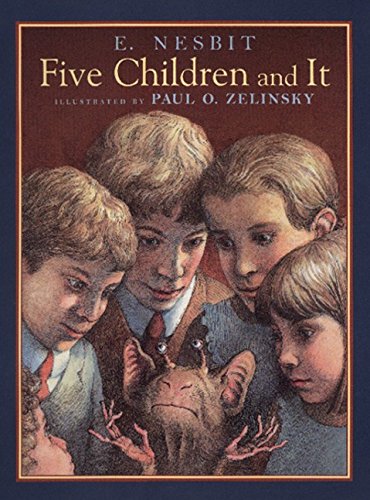
E. Nesbit’s Five Children and It is a fun, fanciful story with an underlying message to “be careful what you wish for.”
A New House
The story opens with the children moving into a new house, which is located at the top of a hill near a gravel-pit and orchard. Their new home has many places to explore around it, but the house proves to be dull.
This prompts the children to go out exploring, and thus their adventures begin.
Absent Parents
Absent or unavailable parents are one of the hallmarks of E.Nesbit’s books. This is probably because, if the parents were involved, the children wouldn’t be allowed to have their adventures.
In the story, the children’s father “had to go away suddenly on business,” while their mother was taking care of their sick grandmother. The servants make sure that the children are fed, washed, and clothed, but other than that, the children are on their own.
We find five siblings, in a large, new house and very little supervision, which always makes for mischief.
(Portrayal of the Sand Fairy from BBC version)
(Portrayal of the Sand Fairy from IMBD newer version)
A Sand Fairy (Psammead)
Nesbit invents a grouchy, sneaky character who will teach the children a lesson. He is called a Sand Fairy, or a Psammead.
The children encounter the Sand Fairy on one of their outings, while they are digging in the sand on the beach.
We find out that the Psammead had been sleeping for thousands of years, but was once famous for its ability to grant wishes. It can grant wishes by huffing and puffing, but only has enough energy for one per day. Each of these wishes disappears at sunset, a rule for which the children become grateful.
The Woe of Wishes
The children do what any ordinary child would: they start wishing right away, without thinking about the consequences.
The first wish that they make is to be “as beautiful as the day.” This results in confusion when they get back home, as no one recognizes them. They are not allowed to come into the house and have dinner. Thankfully, when the sun sets, their wish disappears.
Their next wish, to have lots of gold, equally backfires. Everyone thinks that either the money is fake or the children have stolen it.
Their next wish, which is said in a moment of anger by one of the older brothers, is that everyone would wanted their baby brother (who they call Lamb). You can imagine some of the consequences this brings.
Every time the children’s wishes go wrong, they learn some kind of lesson.
The undergirding message is not only be careful what you wish for, but also an introspective, what do you really value?
I think another lesson along the way is to learn to be thankful instead of always wanting.
Nesbit didn’t write this story as a moral tale, but she notes in the book that morals have a way of creeping into stories.
Literary Connections
As I read this, it made me think of W. W. Jacob’s The Monkey’s Paw, a short story published in 1902 (consequently, the same year Five Children and It came out!).
Both stories are Faustian tales, though Nesbit’s has much more levity in it. In her story, something terrible could result from the wishes, but then the children end up with a less severe consequence. In The Monkey’s Paw, there is an element of the cruelty of fate, which determines horrid outcomes for us no matter how we try to wish them away.
My guess is that these authors just had similar ideas around the same time, as I couldn’t find a definite link between these works. Perhaps this just points to a popular trope at that time.
Movie Adaptations
I have to admit, I was not impressed with the newer movie version when I saw it, as it gives off more of an A Series of Unfortunate Events vibe:
This version changes the story and lesson completely, adding several villain characters and making the Psammead seem smarmy and rude.
I think the older BBC version captures the story a little better, and the Psammead comes off more like a cute Yoda character than an alien. You can watch segments on Youtube:
I am planning to read the next 2 books in this trilogy by E. Nesbit.
Have you read her books and do you have any favorite stories by her?






 Classic Reads