For those who have been following my blog for a while, you probably figured out by now that I’m a big George MacDonald fan.
For those of you who haven’t, you may wonder who George MacDonald is. Let me tell you.
George MacDonald
George MacDonald was a Scottish preacher and writer in the mid-late 1800s. He’s known for his fantasy and for being a great inspiration to C.S. Lewis. He was also good friends with Lewis Carroll and other famous authors.
Aside from his fantasy, George MacDonald also wrote countless Victorian novels, which I adore. Even though I disagree with his theology at times, I love how he shows grace through each of his characters and stories.
The Story
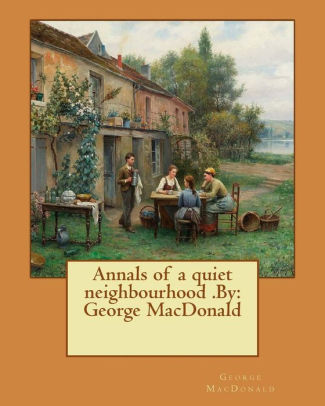
Annals of A Quiet Neighborhood seems, on the surface, like it is the closest to autobiography as anything of MacDonald’s I’ve read. The main character is a minister who studies, preaches, and tends to the many needs of the townspeople.
As you get into the story, you discover that many of these characters have dramatic and scandalous backstories, but all of them are in need of one thing: redemption.
Teaching Moments
As you trudge through the chapters, finding out about everyone in the village and the day to day dramas, there are so many “a-ha” moments where MacDonald drops these gems. They are teaching moments that point out what the narrative has been proving, or interruptions in the narratives to clarify something.
The sensation when you come across one of these teaching moments is like you are wandering through a pleasant, open field and you come across a priceless treasure, that someone has placed there just for you.
Tips on Teaching Theology
One of these gems is when MacDonald makes a point about souls and bodies. The pastor has been going around to visit the sick and dying, and has recently held vigil at the bedside of a woman who talked about death in a way that greatly disturbed him.
MacDonald inserts a correction to a doctrine that he feels is improperly taught, to help his readers to understand it:
“And here let me interrupt the conversation to remark upon the great mistake of teaching children that they have souls. The consequence is, that they think of their souls as of something which is not themselves. For what a man HAS cannot be himself. Hence, when they are told that their souls go to heaven, they think of their SELVES as lying in the grave. They ought to be taught that they have bodies; and that their bodies die; while they themselves live on. Then they will not think, as old Mrs Tomkins did, that THEY will be laid in the grave. It is making altogether too much of the body, and is indicative of an evil tendency to materialism, that we talk as if we POSSESSED souls, instead of BEING souls. We should teach our children to think no more of their bodies when dead than they do of their hair when it is cut off, or of their old clothes when they have done with them.”
MacDonald plays with problems of grammar in describing a metaphysical concept: if we say we have a soul, then that sounds like something that is other than ourselves, and there is a feeling of impermanence.
The point MacDonald is making is that our true self is soul, not body, and it is the body that is shed when we die, not the soul. MacDonald is arguing against the philosophical concept of materialism (now called physicalism sometimes) here, and is possibly arguing for a form of idealism. He is also talking about a commonly-held position among Christians of a mind-body dualism.
Thoughts About Death
Another teaching moment in this story has to do with death. I know this sounds pretty grim, but MacDonald actually offers a lot of hope in this regard:
““To think,” I said to myself, as I walked over the bridge to the village-street—“to think that the one moment the person is here, and the next—who shall say WHERE? for we know nothing of the region beyond the grave! Not even our risen Lord thought fit to bring back from Hades any news for the human family standing straining their eyes after their brothers and sisters that have vanished in the dark. Surely it is well, all well, although we know nothing, save that our Lord has been there, knows all about it, and does not choose to tell us. Welcome ignorarance then! the ignorance in which he chooses to leave us. I would rather not know, if He gave me my choice, but preferred that I should not know.” And so the oppression passed from me, and I was free.”
I thought this insight was interesting. The main character arrives at a feeling of peace about death by realizing that, if Jesus didn’t think it was necessary to tell His followers about what death and “the other side” were like, then it is probably for the better that we don’t know about it.
We have an innate curiosity about death and what happens next, but it is fruitless, as we won’t know until we pass through those doors. Still, even if we don’t have firsthand accounts to tell us what it is like, Christians look to Bible passages about what we can expect. I could probably write a whole blog series on death as it is talked about in the Bible, but for now I’ll leave you with this final thought:
“Then shall the dust return to the earth as it was: and the spirit shall return unto God who gave it.”
Ecclesiastes 12:7, KJV
And this one:
For the wages of sin is death, but the gift of God is eternal life in Christ Jesus our Lord.
Romans 6:23, NIV
If you are a fan of Victorian novels, especially pastoral ones (in a double sense of that word, haha!), then I highly recommend this one.
Book Quotations taken from this ebook version: http://www.gutenberg.org/files/5773/5773-h/5773-h.htm#link2HCH0028
 Classic Reads