There are different interpretations and traditions surrounding the season of advent: wreath-making (here’s a great article with more about this), lighting candles, singing certain songs, and reading specific Bible passages. All of these traditions celebrate one thing: the “advent” (important event) of Christ’s birth.
Each Sunday, I will share a scripture passage and song for the season of Advent. For those who are Christians, let’s celebrate this season joyously together. For those who are not, you are welcome to follow along to learn more about this tradition (and you can feel free to share some of your own).
This Sunday, the first candle symbolizes hope.
Before Christ’s birth, those who believed the words of the prophets waited with hope. Many generations came and went, without seeing their hopes fulfilled. And what were they waiting and hoping for?
“Therefore the Lord himself will give you a sign: The virgin will conceive and give birth to a son, and will call him Immanuel.”
Isaiah 7:14
“The people walking in darkness have seen a great light; on those living in the land of deep darkness a light has dawned. You have enlarged the nation and increased their joy; they rejoice before you as people rejoice at the harvest, as warriors rejoice when dividing the plunder. For as in the day of Midian’s defeat, you have shattered the yoke that burdens them, the bar across their shoulders, the rod of their oppressor. Every warrior’s boot used in battle and every garment rolled in blood will be destined for burning, will be fuel for the fire. For to us a child is born, to us a son is given, and the government will be on his shoulders. And he will be called Wonderful Counselor, Mighty God, Everlasting Father, Prince of Peace. Of the greatness of his government and peace there will be no end. He will reign on David’s throne and over his kingdom, establishing and upholding it with justice and righteousness from that time on and forever. The zeal of the Lord Almighty will accomplish this.”
Isaiah 9:2-7
They were hoping for a light, a king, and Immanuel (which means “God with us” in Hebrew). The prophet Isaiah made these prophecies over 700 years before Jesus was born. He prophesied that a virgin would conceive and give birth, that there would be a child who would be called those names you may have heard in Handel’s Messiah- He would be called by God’s name, meaning He would truly be God.
There were many other prophesies given to Israel over the years, sometimes in dark times when hope seemed lost. But that first candle shining in the darkness reminds us that the light of hope can still offer us comfort and that the darkness is not forever.
This is my 47th post, one day after my 1 year anniversary of starting this blog.
My original goal was one post per week, which would be 52 in a year. My posts were much more sporadic at first, and I was also figuring out how to start my own business this year, so I’ll give myself a break on that one.
Number of followers: 127
Total words : about 35,000
I started this blog to focus on classic literature, but I have many other interests that I like to share and dialogue with others about, too.
Next year (2021), I hope to post 3+ times per week. This will take more planning and discipline, but I am hopeful I can do it.
Books I’ve Covered in the First Year: (Click to see that post)
Any requests or recommendations of classic books you want me to cover in the coming year?
Exciting blogs for the next year:
My husband and I plan to travel to Germany (pandemic-pending!). I had started learning German this past year, and I hope to learn German to a level where I can read fairy tales!
Also, I hope to share more of my own writings, and will be promoting my books as I publish them.
I will still be covering Classics, but I might also venture out into more recent literature.
I will be sharing some book and thoughts on psychology, philosophy, and theology as well.
I also want to share other budding authors’ writings to help them get the word out.
And lastly, I will be giving my blog a little bit of a makeover around the new year, to make it look nicer and more easy to navigate.
Stick around! I’d love to hear how this last year of blogging has gone for you, too!
As we are in 2020, I thought I would share 20 things I have been thankful for in the last year:
My faith is the foundation of my life. Whenever things are rocky or seem hopeless, my faith in God and His plan get me through. I pray, I hope, and I try to live faithfully in the present.
God’s provision and grace have been abundant this year. He has provided good work for me during the pandemic, has given me a great husband to be quarantined with, and many other blessings. God has graciously changed my perspective along the way when I have been tempted to be discontent and ungrateful for the hand we all seem to have been dealt this year.
My husband and our marriage have blessed me and helped me to grow during this time. He’s the kind of person who is very direct and deals with things head-on, which pushes me to face what I would avoid at times. I also learned just what a committed caregiver he can be. He has been very sweet and supportive of me in starting my own business, and he cared for me when I was very sick at one point.
Freedom is a gift I too often take for granted. But the truth is, the country I live in, and the education and opportunities I have access to are gifts that give me the freedom to pursue my dreams instead of simply surviving.
My apartment is a mixed bag, but the truth is that we have it pretty good. Sure, the floors dip dangerously, the doorways are crooked, and there are lots of gaps and holes we’ve had to fill up so that the roaches don’t get us, but we have a place of own that has air conditioning (well, we bought a window unit) and heat! We have a place to live, at a reasonable price for living in the city.
Good friends are hard to find. Seriously. But I have some pretty great ones. Some live far away, and some near, but during the pandemic that hasn’t mattered so much as I talk to almost everyone on the phone or Zoom. I am thankful for the honest, genuine, caring people I can call friends.
Our new church has been a great blessing to us. From prayer support to providing a sense of community, our church has been a source of encouragement to us. We appreciate how the church balances genuinely caring for people with staying true to God’s word.
Health dictates our level of enjoyment and passion for life sometimes. I had an Ulcerative Colitis flare up during the Pandemic, and it gave me a new perspective. I had a potentially life-threatening issue, and it sparked something in me to live with renewed passion and purpose, and to never take the times I am feeling well for granted.
Sleep has been a constant struggle in my life. I have trouble turning off my active brain at night. Yoga, hot baths, herbal teas (especially mint!) can help a little, but then there’s nightmares and body aches that wake me up. The truth is, I am just thankful every time I actually do get a good night’s sleep and am able to awake refreshed.
My clients have helped to keep me on track and productive this year. I am thankful for their patronage and for trusting me to do my best work for them. Many have been a pleasure to work with, and some of the projects have been very fulfilling and exciting for me.
Writing projects have become my thing. I get excited and energized when starting a new project, and I love the satisfaction of getting each part of it done (and done well!). I have some new ones planned for the coming year that I am particularly excited about…stay tuned!
Books have long been my portal to another time and place. This year, they have been the vacation I couldn’t take, and the imaginative places I could explore instead of traveling.
My education has provided me with many different tools. I have come to appreciate the influence and guidance of my BA and MA professors, and have treasured some of the books and concepts they introduced me to. I have been able to build on many of the foundations laid by being trained in literature analysis, Biblical exegesis, research, writing, and the importance of having the right hermeneutical lens (in both a Biblical and philosophical sense).
Entertainment has been a happy escape this year. My husband and I have been fans of the Voice, the Masked Singer, Doctor Who and Stargate SG-1 (and Atlantis), but this year we searched for some new shows. We have enjoyed watching Insane Pools, Star Trek Enterprise, and now the American version of The Weakest Link. I also watch a lot of sappy Hallmark movies. We’ve enjoyed playing games like Splendor, Pandemic (we have like 6+ versions we go between), Catan, Dominion (we have all 13 sets), 7 Wonders, Forbidden Island, and others. Yes, we are nerds 🙂
Good weather and sunshine have been welcome, happy days that energize me, and occasionally tempt me to walk around the loop behind our apartment building (when others aren’t there, of course).
Food (and being able to eat!) can be a simple comfort. Whenever I am not having digestive issues due to Ulcerative Colitis, I am ecstatically happy and enjoy eating immensely. I never want to take for granted that we have access to good healthy foods that can nourish us.
Bath salts are amazing. They can sooth any muscle ache! This year, that has been important as I have overdone the exercise more than once, and my hands and arms get sore from so much typing at times. Also, I love the ones with the soothing essential oils!
This blogging community is great. Truly, there are some wonderful people on WP with great thoughts and interesting stories to share. I have loved reading others’ writing and have appreciated when they read mine, too!
We got an exercise bike about a month ago, and it was a great decision! It has helped us to get some exercise even on the cold and gloomy days, and because it is a low-key exercise that doesn’t feel like work, it has helped me to stay consistent.
Animals and plants are amazing. I have watched my houseplants grow and flourish, and I appreciate the squirrels, birds, outdoor neighbor cats, and trees we can look at out the window. I guess I’m also thankful for windows, too 🙂
What about you? What have you been thankful for in 2020?
So far, I have to admit I have a love/hate relationship with NaNoWriMo. I love that it’s getting me to write MORE, but I’m not convinced that simply writing a large quantity of words helps my life goal of continually learning how to write better.
Total words so far: 25,013
What I’ve learned about Nanowrimo:
It’s fun to hear about others’ writing projects and success, but I have to be careful not to compare myself to them.
I think it is worthwhile to participate because it can add a little external pressure to help me work on the project that is always on the backburner.
The writing time and energy I’m not devoting to the projects on the front burner provides a little tension. I’m itching to put more energy towards my children’s fantasy series.
What I’ve learned about myself as a writer:
Yes, I’m creative. Yes, I can pound it out when I need to. But there’s no getting around the fact that I will have to edit the dickens out of my writing to make it into something I can be proud of.
I have also found that I have a hard time sticking to my outline. I get several chapters in and realize that my character arcs (because I like to have many!) are heading in a different direction, which then changes the plot. I discover certain supporting characters along the way that I didn’t intend on putting in the story, but they show up to move those main characters along.
Sometimes I discover that what I thought my character wanted isn’t what they’re all about. One character becomes more thoughtful and pensive than I thought they were at first, and another becomes a little more impulsive and exciting. Even if I modeled the character after someone I knew at one point in time or a part of myself, that character eventually becomes their own person, distinctly separate from the original inspiration. I only realize this when I think, “this character would do X, but so-and-so (or I) never would.”
Here’s a (very rough) snippet of what I’ve been writing:
Christine was gazing out the window at the birds, and you could hardly tell whether she was paying any attention at all. The truth was, her thoughts were on the date that she had just had. As it had turned out, Charles was a true gentleman, living up to his name.
They had met for coffee and had started an interesting conversation about what religion was and what it meant to have a moral and well-reasoned religion.
Christine had been surprised that Charles knew so much about different religions. He had studied some of them in college and had considered becoming Jewish at one point and then had looked into Islam, and last had come to Christianity looking for some answers.
“What do you think about what Kant says about evil and the world?” Charles asked. “Do you think the world is getting more good or more evil?”
Christine thought for a moment. “Well,” she began, “I like to think that there’s always hope. And even though I do see a lot of wickedness in the world today, I think of times like the middle ages and the holocaust and I have to think things are better today than they were then.”
Charles nodded, a grin on his face. “A good answer,” he said.
“What do you think?” Christine asked.
“I think things are probably about the same,” he said with a wry grin. “I’m a rebel. But if I had to pick a side, I’d probably agree with you,” he hastened to add.
Christine smiled. “What else do you believe?” She asked. “I mean, I know you’re not supposed to talk about religion on the first date, but since we already started…”
Charles winked at her. “I think there’s some truth to Christianity,” Charles had said. “but I don’t know if I’m ready to commit yet. I just have a few problems that I’m trying to figure out. That’s why my friend recommended this book.”
“It seems like your friend cares about you a lot,” Christine had said. “To try to get you to learn more about how to think about religion. The way I think about religion is that it’s not just this structured format that I’m following. It’s not as though I sat down one day and I was convinced by all these different theological positions. Instead, when I was a little girl I used to go to church, and the ladies there were nice and they would tell me stories about God and then about Jesus. They would tell me about his love and his forgiveness and how he healed people. I started to pray to God, and at one point I made a decision that I was going to become a Christian. The funny thing is, I didn’t even know all of their Christian beliefs at that point. I didn’t know what The Trinity was. I didn’t know what it meant that Jesus had died for my sins. I knew the words, but I don’t think I really understood them.”
Charles sat across from Christine at the table, transfixed. He was glued to her every word, his eyes shining and sparkling with interest.
“Now, I understand a lot of things about my faith,” Christine said. “But it’s funny: that’s not what made the decision for me. I think ultimately what it comes down to is faith. I’m not saying that reason isn’t important, because I think it really is, but I think our reason should always back up what we believe,” She said. “I don’t know if I’m being clear.”
Charles nodded. “Yes, you’re being very clear,” he said enthusiastically. “I’m just thankful that you’re being so straightforward with me. I think it’s really amazing that you can articulate things so well.”
The first time I read Frankenstein (read it online for free), when I was getting my BA in English, I expected it to be something similar to the cheesy old Frankenstein movies about a crazy scientist and a horrifying, murderous monster.
Much like my experience reading The Picture of Dorian Gray, however, I was pleased to find that Frankenstein is a deep, thought-provoking work about the human condition with beautifully-written prose.
The Story Behind the Story
In Mary Shelley’s introduction, she tells the story behind the story about how a young, 18-year-old girl in the 1800s came to write a terrifying tale like Frankenstein.
Shelley’s parents were both writers, and she married Percy Shelley, who she says was the real writer of the two. In the summer of 1816, Mary traveled to Switzerland with Percy Shelley, where they spent time with Lord Byron. She describes the summer as a blissful, happy time. So why would she write a tale about reanimating dead flesh?
Well, Mary Shelley was given the task to write a story that would scare the others in their company. As it happened, Shelley and Lord Byron had a conversation about whether the nature of the principle of life could be discovered. Basically, they were talking about the origin of life and the possibility of being able to create it.
Then, Mary Shelley went to bed. That night, she dreamed about some of the horrible things that eventually became Frankenstein. She wrote down a few pages and read it to the others. Percy Shelley was enthusiastic about it and told her that she should make it into a full-length book.
Mary Shelley’s work is quite impressive for an 18-year-old, but she mentions that Percy Shelly helped to shape her novice attempt into the story we read today.
The Story Within the Story
The scene narrative is told by the main character, Victor Frankenstein, who recounts his woeful tale to Captain Walton. Captain Walton had been longing for friendship, and had found all the other passengers on the boat to be uninteresting and uneducated. Then, he finds Frankenstein, who seems so interesting, educated, delicate, and full of emotion. During the Romantic period, these qualities were highly prized.
Education and Natural Philosophy
Victor Frankenstein’s family was very distinguished and affluent. They adopt an orphan girl named Elizabeth as they travel, bringing her back to their home in Switzerland. You might remember, Mary Shelley is in Switzerland at the time that she’s writing this book.
This is what the main character says about his childhood:
“My temper was sometimes violent, and my passions vehement; but by some law in my temperature they were turned not towards childish pursuits but to an eager desire to learn, and not to learn all things indiscriminately.”
There is a proclivity in Frankenstein, the creator, towards violence and giving way to his passions. This is foreshadowing of what is to come, and the kind of creature he will create.
But Frankenstein says these violent passions are turned towards his studies, for:
“it was the secrets of Heaven and Earth that I desired to learn; and whether it was the outward substance of things, or the inner spirit of nature and the mysterious soul of man that occupied me, still my enquiries were directed to the metaphysical, or in its highest sense, the physical secrets of the world.”
Frankenstein is bent on discovering the secrets of creation. He feels he can discover these through the emerging physical sciences. Frankenstein recounts his education and the philosophers that he follows: he reads Paracelsus and Albertus Magnus.
Paracelsus was a wandering physician and medical doctor who looked down on the medical scholarship in the 1500s. In his travels through Europe, Russia, the Middle East, and the Northern parts of Africa, he sought to discover secrets about alchemy and the forces of nature. He sought natural remedies and attacked harmful medical practices in his day.
Albertus Magnus was a thinker during the Middle Ages who studied logic, psychology, metaphysics, meteorology, mineralogy, and zoology. He sought out some of the properties of living things, and that is why I assume he is mentioned here (https://plato.stanford.edu/entries/albert-great/).
Victor Frankenstein becomes interested in studying these thinkers and the origin of life. It is worth noting that the philosophers he follows are known for doing their own work and study outside of the confines of popular scientific opinion and theory.
Then, something terrible happens in Frankenstein’s happy story: his mother dies, and everything changes. Frankenstein returns to his philosophical pursuits with a new feverish curiosity: could something be given life?
“whence I often asked myself, did the principle of Life proceed? It was a bold question and one which has ever been considered as a mystery; yo what’s how many things are we upon the brink of becoming acquainted, if cowardice or carelessness did not restrain our enquiries. I resolved the circumstances in my mind, and determined thenceforth to fly myself more particularly to those branches of natural philosophy which relate to physiology.”
Frankenstein attacks this new passion for study and becomes obsessed with figuring out whether he can give life to something. You know where the story is going.
Romantic Sensibilities
I get so frustrated with Victor Frankenstein! He has to be one of the most irritating protagonists. And yet, he embodies the ideals of the Romantic era, being of an overly-sensitive and emotionally-driven temperament.
Frankenstein creates the Creature, then faints and gets a fever. He actually faints quite often. He focuses on his nerves and mental health, completely ignoring the reality of the creature he just created. He only thinks about himself and his feelings. He is full of self-pity and shame.
“Oh, how I suffer more than those that my creature murdered, and those accused of the murder the creatures commits!”
Frankenstein complains after the first murder has been committed. His younger brother William was killed, and a beloved maid in the family’s house is on trial for the murder. ONLY Frankenstein knows that the creature exists, and he puts two and two together and realizes the creature killed William.
Does he tell anyone about the creature? No.
Does he help the maid in any way? NO.
And yet, he says he suffers more than his strangled younger brother and the maid who is found guilty and put to death. Really?
The Virtue of the Creator and the Created
One interesting connection is if you compare the speech and narrative of Frankenstein and his monster:
After the deaths of William and then Justine, Victor Frankenstein says his heart is still full of virtue, even though he created the Creature who has now become murderous.
“I had begun life with benevolent intentions, and thirsted for the moment when I should put them in practice and make myself useful to my fellow beings. Now all was blasted: instead of that serenity of conscience which allowed me to look back on the past with self-satisfaction, and from thence to gather promise of new hopes, I was seized by remorse and the sense of guilt, which hurried me away to a hell of intense tortures, such as no language can describe.”
Frankenstein sees the virtue in his motivations for his experiment, for he only wanted to discover the origin of life to contribute to the corpus of scientific discovery. But his actions haunt him, as his virtuous intention led to him committing a deed of darkness.
Frankenstein flees into the wilderness to find tranquility, and the Creature appears to him.
The Creature is the most interesting part of the story to me. I sympathize with the monster because he didn’t ask to be created, and he just wants love and acceptance.
And the creature is actually really intelligent. He’s more intelligent and virtuous than all the people who assail him throughout the book (well, at first anyway).
The creature makes a plea to his creator:
“I am thy creature, and I will be even mild and docile to my natural lord and king if thou wilt also perform thy part, the which thou owest me. Oh, Frankenstein, be not equitable to every other and trample upon me alone, to whom thy justice, and even thy clemency and affection, is most due. Remember that I am thy creature; I ought to be thy Adam, but I am rather the fallen angel, whom thou drivest from joy for no misdeed. Everywhere I see bliss, from which I alone am irrevocably excluded. I was benevolent and good; misery made me a fiend. Make me happy, and I shall again be virtuous.”
Frankenstein, who is the only who can and should understand his creation, replies:
“Begone! I will not hear you. There can be no community between you and me; we are enemies. Begone, or let us try our strength in a fight, in which one must fall.”
It is interesting that Frankenstein immediately denies any connection between him and the creature. He fails to see that both he and the creature have committed a heinous act while holding virtue on a pedestal. He doesn’t realize that, like his child, his creature has learned from him, and that Frankenstein shirked his duties as creator and father to the creature by abhorring the Creature from the start. Even now, Frankenstein would send the Creature away and refuse to understand the other.
But Frankenstein is forced to listen to the creature’s story.
The creature has learned how to speak and read from hiding out and spying on a family. He listened to them teaching each other and thinks:
“These wonderful narrations inspired me with strange feelings. Was man, indeed, at once so powerful, so virtuous and magnificent, yet so vicious and base? He appeared at one time a mere scion of the evil principle and at another as all that can be conceived of noble and godlike. To be a great and virtuous man appeared the highest honour that can befall a sensitive being; to be base and vicious, as many on record have been, appeared the lowest degradation, a condition more abject than that of the blind mole or harmless worm. For a long time I could not conceive how one man could go forth to murder his fellow, or even why there were laws and governments; but when I heard details of vice and bloodshed, my wonder ceased and I turned away with disgust and loathing.”
The creature wonders what he is, what he was created for, and who will speak with him. He longs for companionship, and he envies Adam, who gets a special companion created just for him:
“But Paradise Lost excited different and far deeper emotions. I read it, as I had read the other volumes which had fallen into my hands, as a true history. It moved every feeling of wonder and awe that the picture of an omnipotent God warring with his creatures was capable of exciting. I often referred the several situations, as their similarity struck me, to my own. Like Adam, I was apparently united by no link to any other being in existence; but his state was far different from mine in every other respect. He had come forth from the hands of God a perfect creature, happy and prosperous, guarded by the especial care of his Creator; he was allowed to converse with and acquire knowledge from beings of a superior nature, but I was wretched, helpless, and alone. Many times I considered Satan as the fitter emblem of my condition, for often, like him, when I viewed the bliss of my protectors, the bitter gall of envy rose within me.”
The creature is tortured by what he is. When all people do is to turn away from him in horror or try to attack him, he learns violence, fear, and anger. He learns about the world as an infant does, and what he learns is that people will try to attack him and kill him. He got defensive at first, but eventually, he becomes murderous and filled with hate. His sole purpose becomes to punish his creator for making him.
The creature doesn’t want to die, but he longs for companionship and cannot have it. Then, he fixes on another solution: his creator can create a female companion for him (an Eve to his Adam). If Frankenstein does, the creature promises to leave him and his family alone.
Lessons on Life and the Human Condition
I don’t want to give away the ending, but I think the “lesson” of the tale is clear: beware of trying to play God. Also, don’t create a monster from dead flesh and leave it to learn about the world on its own. An important life lesson to keep in mind 😉
This tale also raises some interesting questions about the nature and origin of life:
Are we simply animate flesh walking around, with fleshy computers in our brains that can be turned on with enough electricity?
Is virtue an important part of our being?
Is there a little bit of a devil and an angel in each of us, or are some of us simply created to be one or the other?
What horrible things do we create which haunt our footsteps like a harbinger of our doom?
What fateful deeds have we done in the dark eat away at us, bringing death and darkness, instead of the light and hope we longed for? And what is our escape from those?
As a Christian, I answer these questions with theology, built on ideas from the Bible. I believe we were created by God, to rule over the rest of his creation in a just and loving manner, living by the laws he has given us.
Virtue is a byproduct of living within the bounds of this created order, and it hearkens back to the creator.
We were created with a free will, and therefore the capacity to do good or evil. After the first sin, humans have been bent towards evil (evil begets evil kind of thing), yet we still have the ability to imitate our creator and do good.
I think sin and our misdeeds haunt us, and the only hope is that something outside of ourselves, something good and pure, can make us right again. I believe that Good is Jesus.
Those are some of my reflections and answers to those questions.
Well, I didn’t make amazing progress in this second week. I have the usual excuses: tiredness, doing other work, the malaise that the election and the uprise in the pandemic leaves in its wake.
Still, I am enjoying working on my modern Jane Austen tale, which follows four sisters in their teens and early twenties.
I started with 7,806 words I had already previously written (some of this was outlining), and have now reached 20, 327. That’s less than 13,000 words in the first two weeks, which is not too impressive, but I have to keep in mind that progress is progress!
Hopefully, next week I will have doubled that number, as my workload should be lighter this week.
Here’s a small snippet of what I’ve been able to write so far:
After the incident that Carmen had at Alex’s party, the girls’ mother banned them all from attending any event that she or their father could not attend. She felt that the young people they were associated with were untrustworthy and unpredictable. “I’m not going to allow my young ladies to go around getting drunk at parties and being in the company of young men who have unsavory reputations,” she swore. “ I’m training you up to be young ladies, not just any kind of woman.”
Though most of the girls greatly disliked being punished for an honest mistake by Carmen, Fildegal was glad. After all, it meant they couldn’t go out and make fools of themselves or get into trouble. She felt they should focus on building up their character at home, especially as they were preparing to be wives and mothers.
The social seclusion was a strange transition, as the girls had experienced a good deal of freedom up until then. They were all very excited, therefore, when they received an invitation to a friend’s New Year’s Eve party, which their parents would be attending. They hadn’t been able to get out very much, and so they had spent their days at home working on their homework or, in Carmen’s case, busily talking on the phone to her 100 friends and telling them every single detail of how Billy was such a jerk.
Somehow, Carmen still managed to land herself a date to the New Year’s Eve party, even though she had been locked up for so long. She was bringing along a guy that she had met at the library of all places, one of the few places that she was allowed to go.
Fildegal was a mess. At the Bible conference, she had spent nearly the whole time with Steve’s sister and had seen Steve more times than she could count.
At the end of the conference, her heart had raced when he stepped up on the platform. He shared a special mission project that he was involved in helping children in Africa get the clothing education and clean water that they needed.
She had felt by the end of the conference that if she wanted to get married, he was exactly the kind of man she would want to marry. This had strangely resulted in her increasing inability to have a lucid conversation with him.
Keep in mind- this is a WIP and this is the first draft! But I’ve had a lot of fun thinking of Austen-y plots and characters in a modern, Christian setting. I’ve inserted some parallel characters and events, which will be a kind of a mystery for my readers (dare to dream!) to unravel.
Other NaNo Writers or writers: How are your projects going?
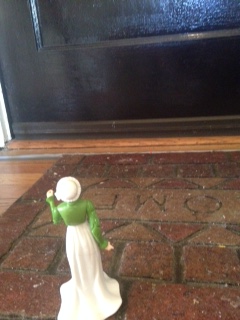
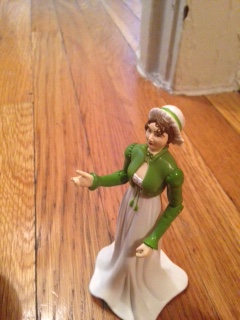
And now, for the conclusion…who is knocking on the door? What gentleman-of-fortune has come to call, and possibly ask for Jane’s hand in marriage?
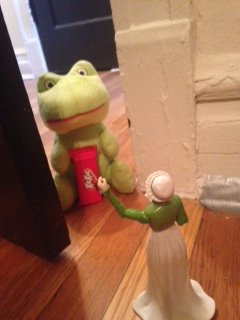
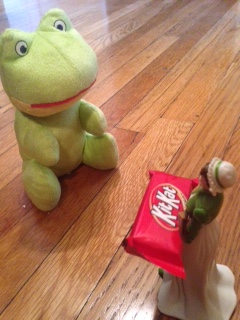
‘Tis Froggy Collins! “Good day, Froggy Collins!”
“Good day, my dear Jane. Dear, dear Jane. You can hardly doubt the purport of my discourse…my attentions have been too marked to be mistaken. Almost as soon as I entered the house I singled you out as the companion of my future life.”
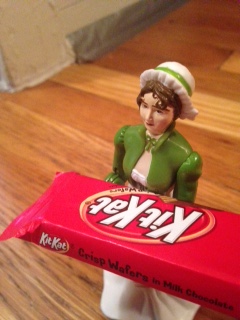
“Oh yes, and I brought some of the finest chocolate in the land as a gift for my future companion.”
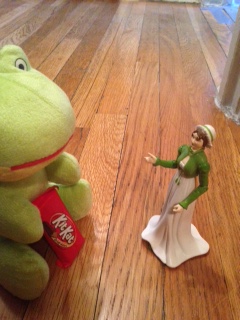
“Accept my thanks for the compliment you are paying me. I am very sensible of the honor of your proposals, but it is impossible for me to do otherwise than decline them. However, it would be insensible of me to decline the chocolate, so that gift I must accept.”
“Fare thee well, Froggy Collins!”
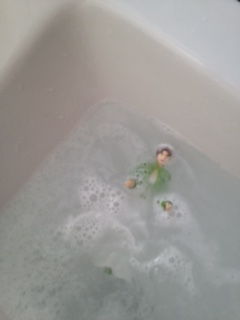
“Now, what to do with all this delicious chocolate? I shall have to send for one of my closest bosom friends to help me partake of it.”
Keeping in mind that I only decided to start NaNoWriMo on November 4th, and not counting any other writing projects I am working on besides my YA Modern Jane Austen novel, here are my stats for week 1:
Weekly total: 6,215 words
Are these wonderfully-written, publishable words? NO. But then again, that’s what NaNoWriMo is all about: just get the bones of your story down and you can go back and make it beautiful later.
Here’s a short excerpt of the non-beautiful (and mostly unedited- gasp) but enjoyable writing I have done:
“Why don’t you help that man instead?” Jared told Christine.
A man had just walked into the store and was looking around as if he didn’t know where to go.
“Sure,” Christine reluctantly agreed. She approached the man. He was tall, and had brown curls which hung down behind his ears. He had a firm jawline and green eyes that sparkled, showing that he was a man of both feeling and intellect.
“Can I help you?” asked Christine. She tried not to stare at the man’s handsome features too much. Her fanciful mind was already making him into a Mr. Rochester or Mr. Darcy.
“I hope so,” the man replied. “I need to find a book in a bit of a hurry.” He looked at Christine, and she thought that she had never seen kinder eyes before. His face was friendly and lively, and she felt oddly at ease with him.
“What are you looking for?” Christine asked, stepping closer to the man.
“Something on philosophy,” the man replied. “ Have you heard of Kant before?”
Christine laughed in surprise. She was in the middle of reading one of Kant’s works. “Of course,” Christine said. “ Follow me.”
Christine walked towards the back of the store, and the man followed her. “Are you a big fan of Kant?” Christine asked over her shoulder, feeling that it would be awkward to walk together silently.
“I don’t know. The jury is still out on that one,” the man replied.
Christine found the philosophy section and scanned the authors for Immanuel Kant. When she found his works, she turned to the man. “ Which book are you looking for?” she asked. She was surprised to find him right beside her.
“Religion Within the Bounds of Bare Reason,” he replied.
“Impressive,” Christine remarked, looking the man over. She didn’t expect someone who seemed so lively and extraverted to be interested in such higher level thought. “You must be a great thinker.”
“No, but I’m trying to learn to be one,” the man confessed humbly. “ My friend is a great thinker and I have tried to learn from him. He told me I should read this book.”
That explained it. He wasn’t a savant, he was just trying to keep up with his intellectual friend.
To my fellow NaNo writers: What projects are you working on? How has your first week been?
I honestly hadn’t heard of NaNoWriMo before I started blogging at the end of November last year.
I am reluctant to join in on the fun because, well, life gets in the way of goals sometimes. And I can be my worst critic when I don’t achieve my goals…
That being said, since I have never done it before, and I know that I CAN write 50,000 words in a month, I thought I would give it a shot.
I’m picking up and dusting off a story I had started about ten years ago (there are many of those!). I had nicknamed it “Modern Jane Austen or Little Women,” as it follows four sisters in the 2010s who are ages 16-22 and are concerned about their matrimonial fates in a Jane Austen type of way.
However, it takes place in New England, like Little Women does, and is very New Englandy (I grew up in MA).
The title is TBD, but the characters are very defined and only partly based off of myself and my sister (I have seven) and the girly silliness that ensued growing up.
It is part comedy, part romance, part drama.
Will anyone ever read it? I don’t know. But it is a story that has been inside me for a long time, and perhaps now is a good time to put the rest of it down on paper.
So, here is me putting this out there: I will add 50,000 words to this story by November 30.
How about you, other Nano writers? What are you working on?




 Classic Reads