Living in Denial of Perfectionism

“I’m not a perfectionist.” “I’m easy-going.” “It’s good enough!”

I’ve said these things SO MANY times! And yet, I think when I say them I am speaking to a part of myself that is so incredibly unsatisfied with the work I produce, no matter how good it is.

As a writer, I have had to confront the reality that I actually AM a perfectionist. I just kind of wish I wasn’t because it drives another part of me insane!

Even this very blog, which has been in draft form for over a week, I am obsessing over at this very moment! I’ve realized I plan, draft, re-write, and then get discouraged, because no matter how much I edit and re-write, it will never be the perfect, flawless, heartwarming yet thought-provoking piece I wish it to be!

Sure, I can tell if it is good. But if I’m honest I’m a little dissatisfied and underwhelmed with “good.”

Hey, I’d settle for AMAZING. I’m not greedy 😉 . But the reality of time, of needing to meet deadlines, and of using my energy wisely and efficiently inevitably all press down on me. My would-be AMAZING piece of writing has to settle for a “good” or even a “very good” in my eyes, most of the time.

The sad reality for this idealist is that I don’t have all the time and energy in the world to pour into my writing like I would like to.

The best I can hope for is that I become a better writer along the way, with each work I produce.

When I have voiced said frustrations, my (wise!) husband helps put things in perspective.

“With art, you’re not creating something perfect, per-say. There are certain aesthetics,” he explains. “And a work of art is considered good when it meets those.”

“But different people use different aesthetics,” I argue (I must always provide a counterargument to make sure we are getting at the reality of the situation- he’s an idealist, too).

“True, but there are some that are more universally accepted,” he continues. “Like a work of art is supposed to be the best version/ expression of what it is.”

“Is this supposed to make me feel better?” I wonder, eyeing him warily. He’s making a point, but I’m not sure yet whether it is helpful to cure my condition.

“You keep trying to make the art the best expression of what it is,” he reassures me, “and at some point it is considered good” (I am paraphrasing and putting his speech in layman’s terms. He is much more eloquent than this).

So, that is where I must rest. How would I ever possibly know when my work has reached “perfection?” The truth is that’s not the right framing for working on something; it’s too simplistic.

As a Christian, I can take the route of saying we are sinful, fallen people in a fallen world and that’s why we can’t reach perfection, but I think that muddies the waters of the conversation about art because my husband is right: there are accepted standards in art, but it is not about it being a certain, perfect way. It is about it becoming what it was meant to be (if you know what I mean!).

As a Christian I can also think about the original Creator, God, and how he creates. He does not make things all uniform or too particular in their aesthetic (or perhaps He merely has a much higher aesthetic than we do, which we are blinded to!). Yet he created and said things were “good.” So perhaps this really is the point in creating. To produce some sort of goodness.

What is perfection, anyways? I think it’s probably just an idea I picked up of the unattainable, a something I dream I could create that everyone (including myself!) would think was wonderful and no one could find any fault with.

In lieu of perfection, therefore, I will continue to write for the sheer joy of creation and learning. I will write to communicate ideas, images, and feelings. I will write to share my inner world with others, to educate, and to inspire. I will write to produce goodness in the world.

What about you? Anyone out there struggling with perfectionist tendencies? What wisdom has helped you along the way?

The Luck of the Scottish in George MacDonald’s The Golden Key

The End of the Rainbow

In Irish folklore, especially of the Lucky Charms variety 😉 , there is a pot of gold at the end of the rainbow. In this charming, aesthetically pleasing Scottish tale, MacDonald has his characters follow the rainbow to find a golden key instead. In this story, MacDonald plays with ideas of light and color, noting that when the boy, named Mossy, decides to set out in search for the key he finds he can only see the rainbow when he is not inside it. He must remain outside it, then, using it as a guide to where he is going.

Allusion

I enjoyed the allusion to Goldilocks and the Three Bears (written 30 years earlier), a story which plagued me with nightmares as a curious little girl with golden locks. But I digress. The allusion occurs when the young girl, Tangle, hears something in the house and imagines that bears have broken in and are in pursuit of her. It is actually a magical creature quite different from a bear, but the girl’s imagination literally (and literarily) runs away with her! She runs all the way into the woods, which is incidentally where Fairyland is (isn’t that always the case?).

Fairyland

There are several curiosities with hidden, ambiguous meaning in Fairyland. First, instead of birds there are flying fish, which “swim” through the air. They are magical creatures which an older woman catches and cooks for Tangle to eat. Once Tangle eats them, she becomes connected with Fairyland in a different way. Her ears become opened to understand the sounds of the magical creatures around her as speech instead of merely noise. Her mind is opened to an understanding of the rhythm of life in Fairyland.

The wise woman explains that Tangle doesn’t need to worry because the creatures she ate were not harmed. Instead, they were transformed once they were cooked, into aeranths, and their new spiritual selves are sent out into the world.

Another curiosity is the land of shadows, which Tangle and Mossy so desperately want to find. They watch the shadows dance around mysteriously and beautifully, stirring a desire to know “from whence they come.”

Interesting Characters, But No Villains!

I had read the whole story through, enjoying MacDonald’s descriptions of the children as they grow and learn in Fairyland, as well as the many characters they encounter along the way, but it wasn’t until I finished and was thinking how pleasant the story was that I realized how much MacDonald had broken faith with fairytale tradition: There were no villains nor evil characters present in the whole story!

This made it no less interesting, however, as the tale became more about growth and learning. The children were separated and had to learn on their own, meeting the Old Man of the Sea, the Old Man of the Earth, and the Old Man of the Fire (I am left to wonder why there is no Old Man of the Wind, the fourth element, but perhaps that is represented in the wise woman, a character MacDonald uses in At the Back of the North Wind as the wind itself).

Finding the Key

Mossy does find the golden key at the end of the rainbow, but sadly he dies before he finds the keyhole which he is to place it in. After he dies, he meets up with Tangle. They are both old and young at the same time (you really have to read it to understand this), having died and being ripe and old enough to enter the land of shadows, while being young in the loveliness that their bodies have grown into. They find that the key opens up a way for them to climb the rainbow to finally reach the land they longed for, the land from whence the shadows fall.

Thoughts

This was a beautiful, sad, joyful and mysterious story all at the same time. It reminds me why I fell in love with George MacDonald’s writing in the first place. He has an ability to hint at deep meaning and stir something within me that makes me ask “what is does this all mean?” and at the same time be satisfied to not have all the answers. The true satisfaction in exploring the deepest mysteries of the soul isn’t that they have one meaning or solution. It is a joy just to walk those hallowed halls and wonder “what is all this?” with moments of “ah, now I understand!”

There’s an illustrated version by Maurice Sendak and an audiobook version available on Amazon! (Click picture to follow link)

Cross Purposes

A Painting Titled “Cross Purposes” by Marcus Stone

Background

I wasn’t familiar with the term, “cross purposes” before reading this small, fun fairytale. According to Merriam-Webster, they are, “purposes usually unintentionally contrary to another purpose of oneself or of someone or something else.”

See if you can spot any of these in this delightful tale!

On an authorial/ historical note, I found it interesting that in this tale, George MacDonald has an upper-class Alice who finds herself led into a fairy world, just like his friend, Lewis Carroll. According to U.C. Knoepflmacher, in the narrative MacDonald is having fun with distancing his Alice from that of his friend, whose Alice in Wonderland was published before MacDonald’s Dealings with Fairies, the collection of stories which contained Cross Purposes.

Amusement and Trickery

Nothing is as it seems in this tale of dual worlds! MacDonald plays with the idea that the ordinary and real are blurred with the fantastical and a deception of the senses.

“No mortal, or fairy either, can tell where Fairyland begins and where it ends.”

For some reason, the fairy Peaseblossom’s appearance on Alice’s bed reminded me of the unwanted appearance of Dobby the House-elf in Harry Potter and the Chamber of Secrets. Unlike Dobby, however, Peaseblossom isn’t loud and insistent that Alice not go somewhere. Rather, she asks tricky questions to get Alice to consent to go into Fairyland with her. Then, a transformation takes place, where first Alice finds she has shrunk (a nod to Lewis Carroll’s Alice), then finds that her bed has transformed into bushes and heather.

To every question Alice asks, the fairy responds with riddles which have a double meaning. For example, when Alice asks how far from home she is, Peaseblossom replies, “The farther you go, the nearer home you are.” I take this to be MacDonald commenting on the “home” of truth that can be found in fantasy, and how a fantastical world can be used to lead one further into reality by revealing such truth.

Richard’s introduction to Fairyland is through a different sort of trickery, by the goblin, Toadstool. First, Richard sees a little man selling umbrellas, which soon begin to lay eggs. Richard discovers the umbrellas are actually geese. Then, chaos breaks loose as one of the geese transforms into a hedgehog when Richard picks it up, and a turkey drives the rest of the geese down the lane towards a forest. Out of curiosity, Richard follows the strange flock. Toadstool finally reveals himself, as he was disguised as the turkey, and takes Richard to Fairyland via a conjured rivulet, on a large leaf that serves as their boat.

The only end to the trickery of these two impish creatures is when the children assert their will. For, it seems, a rule of Fairyland is that a creature can’t interfere with freewill.

Class

It is interesting how Alice’s snobbery leads her to reason that a lower-class boy could not have gotten into fairyland, as it seems like a privilege he would be denied.

Alice is a, “daughter of a squire, a pretty, good-natured girl, whom her friends called fairy-like, and others called silly.”

While Richard, “was so poor that he did not find himself generally welcome; so he hardly went anywhere, but read books at home, and waited upon his mother.”

While they are wandering in the dark of Fairyland, Alice finds it strange that Richard seems so comfortable and confident there, for, “he is quite a poor boy, I am sure of that. His arms stick out beyond his jacket like the ribs of his mother’s umbrella. And to think of me wandering about Fairyland with him!”

Nevertheless, as Alice is afraid and silly and Richard is very brave and sensible, an unlikely companionship develops between the two of them in Fairyland.

At the end, however, the closer they get to the land of mortals, the more they feel themselves pulled apart, by the tricks of Fairyland, and then eventually by the reality they return to in their own world. It seems that when they re-enter the real world, despite how they have gotten over their differences and formed a friendship in Fairyland, they must return to their class structure, and thus are separated.

Love

My favorite part of this story was when Richard’s eyes illuminate Alice and make her appear lovelier and lovelier, because he is looking at her through the eyes of love.

“the fact was, that the moment he began to love Alice, his eyes began to send forth light. What he thought came from Alice’s face, really came from his eyes. All about her and her path he could see, and every minute saw better; but to his own path he was blind.”

Soon Alice sees Richard’s face through the dark in the same way: with a light from her own eyes, and he appears to her to be handsomer than before. She wonders at the phenomenon occurring: “Can it be that I love the poor widow’s son?” but she is “not disgusted” at the idea.

How true this is when we look at someone we have begun to love! Whether a significant other or friend, our perception of them changes and we begin to see more of their beauty when we view them with love. I daresay this is how God comes to see us as good and lovely creatures. He sees us in such a way as He looks on us with the eyes of love.

What is the Fairy World?

What is this land the boy and girl are taken to? What sorts of rules govern it?

It seems MacDonald makes the point that someone from any background could enter it, and in this case there is both a girl and a boy, upper and middle class who enter it.

I take the Fairyland to represent the imagination, and the boy and girl to be unlikely playmates. Though they can enjoy each other’s company in their secret, imaginative play world, the real world would not allow them to stay together. In Fairyland, they can learn (and unlearn!) about life, relationships, boundaries, and possibilities. And, according to the story, Fairyland is closer than we think…pressed up against our reality, only waiting for our willingness to journey into it.

Audiobook: https://www.youtube.com/watch?v=o-V6Rs5wWto

What Every Writer Must Decide

I’m the type of writer who can bend. I can ghostwrite in many types of genres. BUT…how much bending is too much? I think I just found out.

Without revealing details about the situation, I will have to speak in generalities. I want to share what this taught me but I don’t want to be unprofessional.

Every writer has to decide whether they will write what is “authentic” and what “expresses themselves” in their creative act or whether they will write what sells. I would LOVE it if what sells was authenticity, all the time. But the truth is, categories of literature (or other forms of artistic expression) get created and the form becomes narrowed until you have to fit a certain mold for (most) people to be interested.

On rare occasions, someone has success who doesn’t seem to fit the mold. Sadly, most writers will probably not experience this.

And so, most writers must write for an audience and not for themselves. One writer who comes to mind is Louisa May Alcott. She is best known for Little Women. Ironically, she didn’t like it! She wrote it for money and to help her father to get his own manuscript published. She would have rathered that the women didn’t have to get married off.

The point is, sometimes we have to choose. Will we bend in the wind or stand against it? Or is there a true middle ground?

With my own novel I am writing, I am wrestling with this as well. I love classic literature. I want to imitate some of my favorites and bring my own creativity to the table. The risk is, my book will be different from the popular children’s fantasy out there. Sure, I can add a couple conventions to try to make it sell…but do I want to?

What do you think? How much do writers need to write for the market, and how much can they express themselves as artists? Do you prefer to read books that are popular or ones that are unique?

The Dark Side of Light in MacDonald’s The Light Princess

Replete with metaphor and symbolism, word-play and charming innocence, George MacDonald’s The Light Princess is always a treat to re-read.

My favorite types of books to read are ones with layers of meaning, which still retain their aesthetic appeal. As I re-read this classic children’s fantasy, I admired the depth and imagination MacDonald brought to the simple tale.

Background

I have loved George MacDonald’s stories since I was a little girl. As he was a former pastor with a flair for the fantastical, I always found his works to be full of mystery and hidden meaning, just beyond my grasp.

I appreciated how U.C. Knoepflmacher put it in the introduction to the Penguin Classics edition of MacDonald’s Complete Fairy Tales:

“These fictions best dramatize MacDonald’s long distrust of ready-made systems and conventional assumptions—“adventitious wrappings” that he, like Thomas Carlyle, his fellow-Scot and mentor, set out to “re-tailorize.” Addressed to both children and adults, MacDonald’s fairy tales enlist paradox, play, and nonsense in a relentless process of destabilizing priorities he wants readers to question and rethink.”

Basically, George MacDonald defied the stereotypes of fairytale and fantasy, and didn’t offer clear-cut morals and meanings. It is one of the most delightful and frustrating elements of his writing. There are a few elements of the story which stand out, the concept of lightness being the dominate one, so it is to that I will turn my attention first.

Lightness

It is with lightness that the play on words begins- for the princess is light in body, and gravity does not work on her like it does on other people. The “gift” was given to her as an evil curse, from the King’s sister who felt slighted. At her christening the wicked sister speaks the evil words,

“Light of spirit by my charms, Light of body, every part, Never weary human arms— only crush thy parents’ heart!”

And the work is done! Thus, being “light” descends like a cloud of darkness upon the princess.

She is soon tumbling up through the air instead of down, as gravity does not affect her like it does to others. She is also light of spirit and cannot feel sadness or remorse. This may seem appealing at first, but don’t underestimate the gravity of the situation! MacDonald proves throughout the tale that this is a tragedy.

Her condition vexes her parents, the king and queen, who experience her lightness of heart as insensitivity. She cannot feel empathy for another and becomes a creature of her own sort, living in emotional isolation.

Materialism vs. Spiritualism

And what do her parents do to try to solve the issue? They bring in metaphysicians, another play on words, as they are both portrayed as philosophers and “physicians” in the sense that they are trying to figure out how to cure her.

One is a Materialist and the other, a Spiritualist. Sadly, neither are able to arrive at a humane solution for solving the dilemma, for the Spiritualist approaches matters as being completely of the mind which can be solved through forced study of every area of earth’s history. The Materialist, on the other hand, treats the issue as being of the body, and even goes so far as to suggest physical measures such as lobotomy and risky procedures that could result in her death!

I think MacDonald is having a little fun here ragging on philosophical positions. I would venture he is suggesting that both extremes can be unhelpful, especially when dealing with actual human beings.

Sacrifice

As the story moves on, the question remains: how will the Princess become acquainted with gravity and being grounded? The problem is ultimately given a metaphorical solution: she “falls” in love. Or at least, under its influence.

She is cured through the loving sacrifice of another: a dear Prince who offers to stand in the hole at the bottom of her beloved lake, which has all but dried up.

As he stands there, the water begins to build up around him and oddly enough he begins to sing (as is frequent in MacDonald fairytales!). His song concludes with:

“Lady, keep thy world’s delight; Keep the waters in thy sight. Love hath made me strong to go, For thy sake, to realms below, Where the water’s shine and hum Through the darkness never come: Let, I pray, one thought of me Spring, a little well, in thee; Lest thy loveless soul be found Like a dry and thirsty ground.”

The prince’s words are a wish and prayer for the princess, even as he waits to meet with his end. He wants her to realize the meaningfulness of his loving sacrifice for her, and to be able to experience love herself. Being too light-hearted has made her unable to feel it.

Literary Connection?

As I was reading this story, something struck me as familiar. I wondered if it, in part, inspired J.M. Barrie’s Peter Pan. There are similarities, mostly being the ability to defy gravity along with a certain lightness of heart. There is also a shared proclivity for mischief between the Princess and Peter, and as a fellow Scotsman who probably had read MacDonald’s tale, I’m sure there was some at least unconscious influence here.

Movie Versions:

I didn’t know BBC had made a movie version of this! It is hilarious, made circa 1985 with cheesy cartoons mixed with real people which I’m sure was cutting-edge at the time.

 movie version: https://www.youtube.com/watch?v=9dPVdAcvxWY

They’ve also made musicals based on The Light Princess. It makes sense, as MacDonald put a bit of singing in it to begin with.

Now, I noted at the beginning that MacDonald was not trying to convey a simple, tidy message through this tale. However, I think from the themes of the tale lessons can be drawn about not being too light-hearted in life, the importance of being grounded, and that true love is sacrificial, laying one’s life down for another (incidentally, a very Christian theme, too!).

So…what do you think? Is being too “light-hearted” a bad thing? Are you a fan of fairytales? Ever read old Scottish ones such as this?

If you’re interested you can get your own copy! It usually comes in a collection of his stories. Also, Project Gutenberg has man of them available online! http://www.gutenberg.org/ebooks/author/127

A Post about Future Posts

Admittedly, I have a problem keeping consistent in my postings…I promise myself I will post at least once a week, make a plan, begin to execute, and then…life.

As a ghostwriter/ freelance writer, lately all I have been doing is writing! Writing until my hands get sore (which inspired me to get an ergonomic keyboard, which I highly recommend!). Writing until no more words come. And then…my blog becomes something that is always on the backburner.

So, here is me putting a promise out into the void of cyberspace, which will hopefully shame-inspire me (if you know what I mean) if I slip into not posting again!

I am doing this blog mostly as a project for myself, to force me to be vulnerable and put my writing out there, to practice using my voice and discussing my passions. But, like most things I do for myself (read for fun, paint, meet up with friends), it gets buried when things get busy!

So I am telling myself, “Self, you will post once a week, by Saturday, no matter what! Put down your work and do it. There will always be more work to do…carpe diem! Walk on the “wild side” and push your project up to its deadline if you have to. Or else…the burying will continue.”

I will be posting this week about George MacDonald’s The Light Princess, which I finished re-reading days ago. It is a delightful and fascinating fairytale! I hope you will enjoy 🙂

The Voyage of The Dawn Treader Blog 2

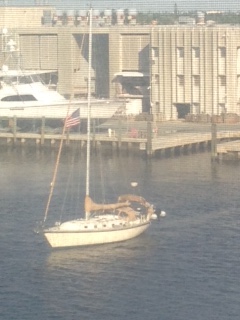
A couple weeks ago I visited my sister in Florida and watched the boats coming into harbor. This seemed oddly appropriate as I had begun reading through The Voyage of the Dawn Treader. The main difference (aside from the make of the ships) was that the children in Dawn Treader were on a large ship for many months with much less plushy accommodation. Now to conclude my observation of the essential themes…

Pride/Vanity

Yet another theme which is worth mentioning, though it is not one of the main ones, is pride and vanity. This one is particularly poignant for me, having grown up in a household full of women (I have 7 sisters). How we looked and how we felt about ourselves based on our looks was always a source of anxiety, competition, and jealousy.

The moment in the book which best highlights this theme is when Lucy goes to find the magician on the island of the Dufflepuds.  Her long-growing jealousy of her sister Susan comes to the surface when she stumbles on a spell to make her beautiful. Susan was formerly noted in the book as getting positive attention from others because she was a great beauty. Lucy sees in the magical book a resulting scenario from saying the spell where she could become even more beautiful than Susan.

 “And Susan was jealous of the dazzling beauty of Lucy, but that didn’t matter a bit because no one cared anything about Susan now”

Lucy determines to say the spell, but when she looks back at the book she sees the face of a lion, growling and showing his teeth. Startled with fear, she quickly turns the page.

Lucy utters the next spell she is tempted by, however, and eavesdrops on her classmates. She hears the girls saying rude things about her and grows angry.

When she finally finds the spell she is looking for, the one to make the Dufflepuds (and all else invisible) visible, she casts it and Aslan appears. He informs her that he was one of the things the spell made visible as he had been there all along. He rebukes her for giving in to temptation to listen in on her classmates. Lucy realizes her motivations for saying the spells had been wrong.

Yet, the very reason Lucy has to find the book and say the spell is because the Dufflepuds had asked the magician to turn them invisible because they were embarrassed about the way they looked.

The magician explains only the Dufflepods considered themselves ugly, when the magician was sure he had made an improvement

Lucy, ironically, asks if they are conceited, to which the magician (when he finally shows up) replies:

 “They are. Or at least the Chief Duffer is, and he’s taught all the rest to be. They always believe every word he says.”

Lewis exposes the way our vanity can become a source of false pride to us. Instead of having a healthy view of ourselves, we can overcompensate for our shortcomings by finding something about ourselves we think is worth admiring and focusing on it to the extent that we feel it defines us.

Lucy is prideful and vain just as much as the Dufflepuds. And even the Dufflepuds, as simpleton as they are painted, are not excused for being so. All must learn to have a right view of themselves.

Expiation

Expiation is a big word we don’t normally use. I am talking about the concept of removal of sin. Lewis displays this through the character of Eustace, who begins as a complaining, sniveling, demanding, bullying and patronizing individual.

One of the most gripping, heartwarming, and painful moments in the book is when Eustace finds himself turned into a dragon. This brings about a positive character change, as he becomes anxious to help others, instead of merely wallowing in self-pity.

One night the great lion Aslan comes to help him remove his scales. Eustace removes some layers himself, but Aslan has to remove the deep layers.

“So I scratched away for the third time and got off a third skin, just like the two others, and stepped out of it. But as soon as I looked at myself in the water I knew it had been no good.

“Then the lion said—but I don’t know if it spoke—‘You will have to let me undress you.’”

“The very first tear he made was so deep that I thought it had gone right into my heart. And when he began pulling the skin off, it hurt worse than anything I’ve ever felt…”

Anyone who has done a bit of self-reflecting knows how painful it can be to own up to our own insufficiencies and wrongdoings. What is more painful, for the Christian, is to let God show us the depth of the wickedness, which goes deeper than we realize. He is also the only one who can remove it all, if we will let Him.

The Voyage of the Dawn Treader Blog 1

In re-reading this children’s fantasy classic, I found it so rich, deep and interesting that I’ll have to break it into 2 separate blogs to do it justice.

Why Eustace is a Bully

As I re-read my second favorite book from the Chronicles of Narnia, The Voyage of the Dawn Treader, I found myself oddly empathizing with Eustace!

Lewis portrays Eustace as the bully and nag, who makes everyone else miserable. At least at first.

Yet, as I read about his parents, who seemed to be rigid and formal, and his strange hobbies he had developed as an only child, I realized that he must be a very lonely child. This was further impressed by reading his diary entries along the way. He has an, “everyone is against me,” sort of mentality, coping with reality by pretending that he is better and smarter than everyone.

Lewis writes that the first time Eustace feels lonely is when he wanders off on one of the islands, but I read that as an awakening to a feeling that was there all along, only Eustace couldn’t feel it per-say because he had other ways of coping that were covering it up.

This may seem like a strange way to read a children’s fantasy novel! However, I think it is quite relevant, especially in today’s age of technology and anxiety, where children experience large degrees of loneliness and lack of essential care.

I don’t excuse Eustace’s response to this, of bullying and picking at those around him. However, in an odd, psychologically need-fulfilling way, I think this is his attempt to connect.

If he can get a rise out of the other person, he is satisfied. Why? It gives him power. But it also shows that the other person sees him, notices him, and is reacting to him. This can be validating to someone who has no siblings, no friends, and is neglected by their parents. Food for thought.

The Story

The story takes place several years after The Lion, the Witch and the Wardrobe, and is only a year after the children helped a young Prince Caspian take back his kingdom in Narnia from book II (Prince Caspian). There is a noticeable absence of Peter and Susan, who are older and doing other things when Edmund and Lucy get swept off to Narnia on another adventure.

Quest

The story reads like an epic. Lewis loved old, classic literature, and I’m sure that epics such as The Odyssey inspired him.

The quest the children (and subservient adults, in a role reversal) are on is to find Prince Caspian’s late father’s friends who Caspian’s Uncle Miraz had driven away. Caspian nobly hopes:

“to find my father’s friends or to learn of their deaths and avenge them if I could.”

It is noted that there is another, higher hope for the quest, held by Reepicheep, the diminutive yet heroic mouse:

“Why should we not come to the very eastern end of the world? And what might we find there? I expect to find Aslan’s own country. It is always from the east, across the sea, that the Great Lion comes to us.”

Bullying

“Eustace Clarence disliked his cousins the four Pevensies, Peter, Susan, Edmund, and Lucy. But he was quite glad when he heard that Edmund and Lucy were coming to stay. For deep down inside him he liked bossing and bullying…”

As mentioned, Eustace plays a pivotal role in the book. Hence, bullying becomes a main topic. Eustace bullies those who are smaller than himself to make himself feel more powerful. One such instance is when he sees Reepicheep tail hanging down and is tempted to swing him around by it. However, the valiant Reepicheep is not one to be bullied, and

“the next thing Eustace knew was two agonizing jabs in his hand which made him let go of the tail…”

Reepicheep then challenges Eustace to a duel to settle their dispute. Of course, Eustace cowardly declines, insisting it was just a joke. The bully is found out for his true cowardice and his attempted humiliation of another becomes his own.

Bravery and Cowardice

This brings me to another theme I picked up on, which was the dichotomy between bravery and cowardice.

As the crew aboard the Dawn Treader draw near to an Island of darkness they find a stranger in the water who comes aboard with a warning that they shouldn’t go to the Island, for it is where bad dreams come true.

The crew succumb to fear and dread, attempting to steer away from the Island. Their minds become muddled by their fear and they begin to despair. In the midst of it all, Lucy cries out to Aslan, who responds to her call by telling her to be brave.

At the end, when one of them must sail on, to the end of the world, the valiant and now beloved mouse, Reepicheep, decides he will be the one to go. For, he reasons, he will reach Aslan’s country that way.

To Be Continued…In the meantime, if you want to grab you own copy you can do so here:

Why Fantasy Matters

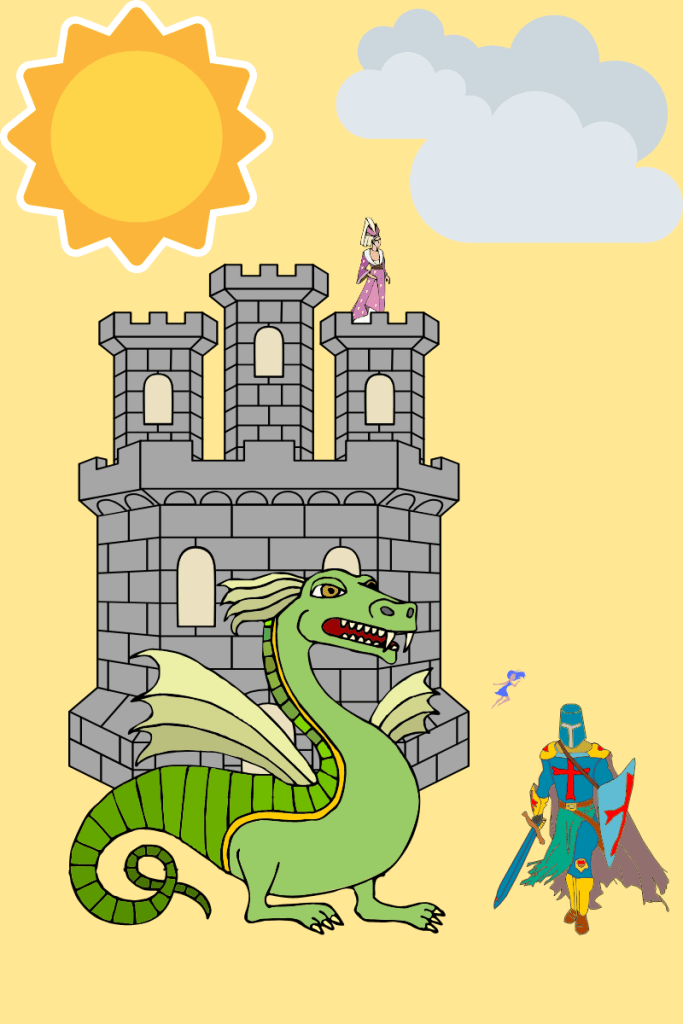
A Fairytale Image I made from Canva for fun

Lately I’ve been wondering, why do people love fantasy literature?

For me, I think the love began when I was a child, getting wrapped up in the magical lands I could only discover in fairytales. My parents read fantasy books to us sometimes at bedtime, which must have influenced me.

Whatever the reason, Fantasy caught my imagination in a special way from a young age. I remember whenever I went to the library as a child I went straight to the fairytale section.

There, I discovered such wonderful picture books of fairytales I will always treasure. Here are two unique picture books that stuck with me:

Princess Furball is a wonderful story similar to Cinderella, as she is a beautiful princess who has glamorous dresses, but she disguises herself as a muddy, fur-claden cook to gain entry to the castle. It has beautiful, memorable illustrations and the hallmarks of a brave heroine determined to win the heart of her prince.

The King’s Equal is a story about a young woman who lived on a mountain, with a mission to take care of what her dying father left her, including a sheep. When a wolf threatens that mission, she finds that the wolf is actually a wise guide, who teaches her until she becomes the most wise, intelligent, and beautiful woman in the land.

When the King declares he wants to find a woman who is his “equal,” the woman from the mountain appears before him in all her beauty and grace. He declares her to be matchless in her beauty and wisdom, therefore admitting he is not equal to her. In a twist, he must now go spend time on her mountain until he becomes her equal, for his character is lacking.

As I am re-thinking and doing some more writing for my own children’s fantasy book, I found this article about the relevancy of children’s fantasy to be helpful and encouraging.

I loved how the author expresses part of the appeal of fantasy literature, which resonates with me:

“One of the most obvious benefits of fantasy is that it allows readers to experiment with different ways of seeing the world. It takes a hypothetical situation and invites readers to make connections between this fictive scenario and their own social reality.

Fantasy writing, says Stephens, operates through metaphor – so that the unfamiliar is used to stand in for, or comment upon, the familiar. Metaphors are obviously less precise than other forms of language (they are subject to more complex interpretive processes) and this is perhaps a significant advantage of fantasy over realism.

Fantasy’s use of metaphor makes it more “open” to different readings and meanings. This allows fantasy to explore quite complex social issues in ways that are less confrontational than realism because it takes place in a world that is distanced from social reality (and can also be mediated with humour).”

What are some of your favorite fantasy stories and fairytales?

Classic Childrens Fantasy

By far, this is a favorite category I enjoy reading and writing in. Sometime this year I even hope to publish my own children’s fantasy novel…

For now, let me share with you a some of my favorite children’s fantasy classics which I will be blogging about in the coming months. Click on any of the books to find more information or purchase on Amazon!

Feel free to share about some children’s fantasy classics you love as well!

Design a site like this with WordPress.com
Get started